
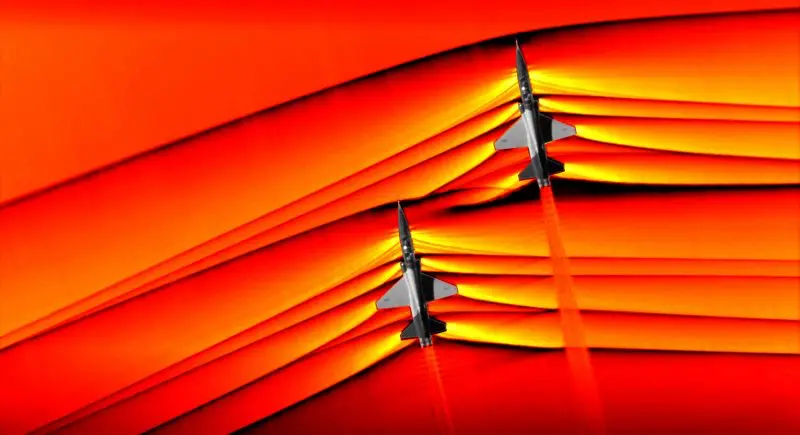
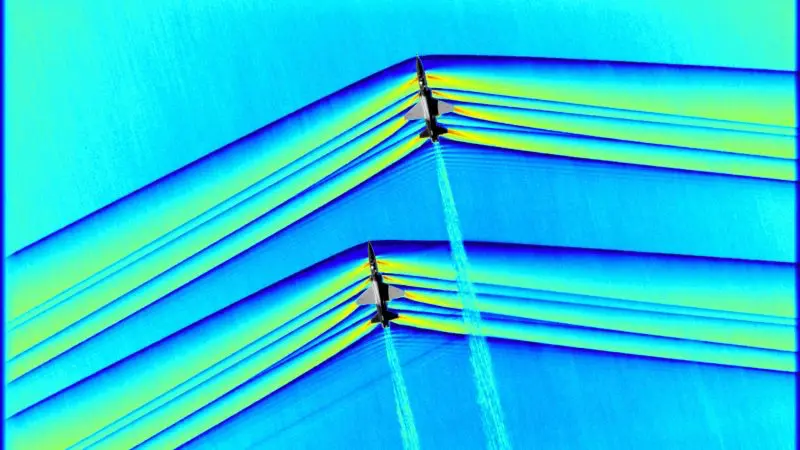
The NASA, after 10 years developing an innovative "air-to-air" photographic system, managed to photograph 2 jets at the exact moment of breaking the sound barrier, which occurred at the exact same moment for both aircraft.
The images depict 2 supersonic jets T-38 of the US Air Force during a test flight from the research center at Edwards Air Force Base in California.
These images were captured by a King Air B-200 flying at 30 thousand feet, 2,000 feet above the 2 jets photographed. A very complex calculation allowed this innovative photographic system (1,400 frames per second) to capture the breaking of the sound barrier by the 2 jets below it at the precise moment the jets passed (at much higher speed) beneath this photographic system.
The images required extremely precise flying by the US Air Force pilots who had to fly only 30 feet apart from each other in order to observe the behavior of the simultaneous shock waves.
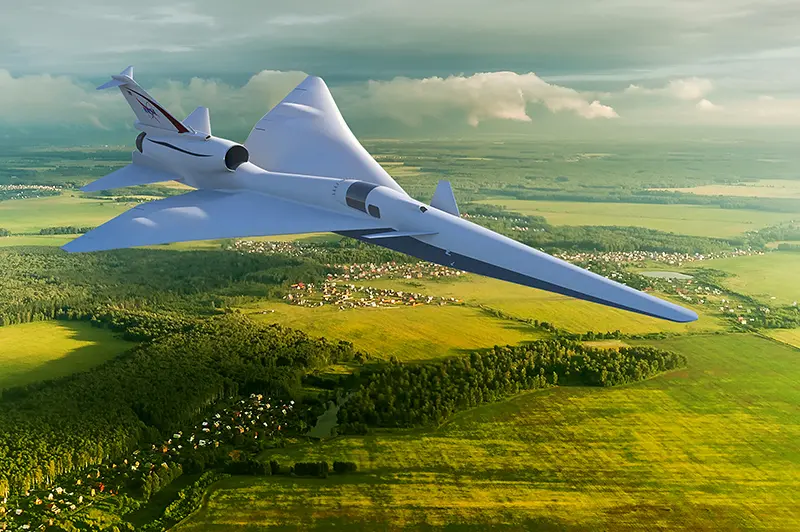
The photographed material will be used to acquire important data to develop the "X-59 Quiet SuperSonic Technology X-plane", NASA's supersonic aircraft, which will be capable of flying without producing the classic deafening noise when breaking the sound barrier.
The ability to fly without a "sonic boom" could one day lead to changes in current restrictions on supersonic flight over land. To date, there are precise rules that prohibit aircraft from flying beyond the sound barrier to avoid "disturbing" people on the ground with the deafening noise caused by such passage.
The speed of sound in air is equal to 1,192 km/h at a temperature of 0 degrees and 1,237 km/h at a temperature of 20 degrees. This is why commercial flights typically travel around 900-1000 km/h.
If NASA, thanks also to these spectacular images, manages to build an aircraft that can break this sound barrier without generating the deafening noise, new frontiers in aircraft construction would open up.
Dan Banks, senior research engineer at NASA, told CNN that the "quiet" aircraft is currently under development at Lockheed Martin and that its first test flights are planned for 2021.
The new photographic technology used is "very significant" and allows researchers to model real shock wave patterns, rather than relying on computer models, which always contain "some differences."
"We are seeing a level of physical detail here that I don't think anyone has ever seen before", said a NASA researcher. "Looking at the data for the first time, I think things went better than we had imagined. This is a big step forward."



