
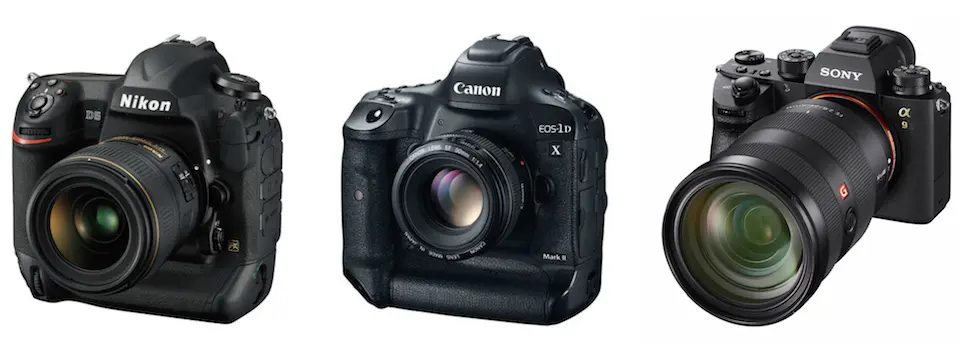
With the release of the new Sony A9, monstrous full-frame mirrorless from the Japanese company, professional photographers who need shooting speed and excellent quality now have a third choice besides Canon and Nikon.
No one yet, not even I unfortunately, has had the chance to try the new Sony A9 firsthand, and for this reason, we don't know how it will perform in the field.
Certainly, the good premises are there; in the meantime, let's try to make a brief outline of the main technical features of the flagship models from the 3 most well-known camera manufacturers.
Below I have tried to summarize the differences between the Nikon D5, the Canon EOS 1D X Mark II, and of course the new Sony A9.
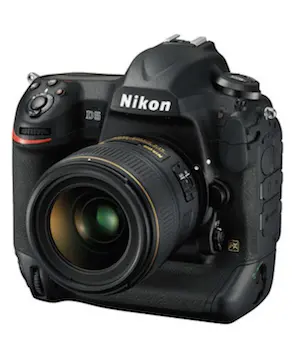 | 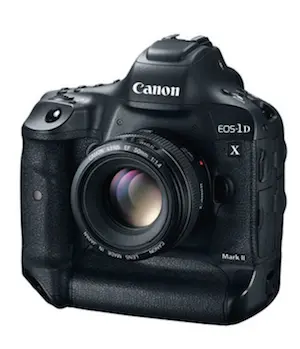 | 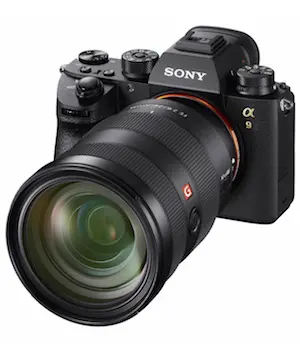 |
| Sensor | 20.8 megapixel CMOS | 20.2 megapixel CMOS | 24-megapixel, "stacked" type CMOS |
| ISO Sensitivity Range | 100 - 102.400 | 100 - 51.200 | 100 - 51.200 |
| AF points | 153 AF points and 99 cross-type sensors | 61 AF points and 41 cross-type sensors | 693 phase-detection AF points with 93% coverage |
| Shutter Speed Range | 30" - 1/8.000 | 30" - 1/8.000 | 30" - 1/32.000 |
| Burst Rate | 12 fps, 14 fps with mirror up. Buffer up to over 200 JPGs | 14 fps, 16 fps with mirror up. Buffer up to 173 RAW or unlimited JPGs | 20 fps. Buffer up to 241 RAW or 362 JPGs |
| AF Sensitivity | -4EV | -3EV | -3EV |
| Video | 4K (3840 x 2160) at 30p; full HD at 60p; 1.5x crop during 4K | 4K (4096 x 2160) at 60p; full HD at 120p; 1.3x crop during 4K | 4K (3840 x 2160) at 30p; full HD at 120 fps |
| Battery life | 3780 shots | 1210 shots | 450 shots |
| Body only weight | 1235 grams | 1340 grams | 673 grams |
| Body only price | About 5800 euros | About 5500 euros | About 5000 euros |
Impressions
The Nikon is definitely superior to the others in terms of low-light performance, the ISO sensitivity up to 102,400 allows shooting images practically in the dark!
Although we have no video evidence with Sony, Canon seems to have superior video quality compared to its rivals, especially in 4K recording at 60p compared to 30p of other brands.
On paper, Sony seems to be the fastest of all. In addition to crazy bursts at 20fps, Sony can push shutter speeds up to 1/32,000 sec, which can practically freeze any action. On the downside, Sony has a battery life significantly shorter than Canon and Nikon, although it has clearly improved compared to the previous A7 version.
Finally, price and weight definitely lean in Sony's favor; although it costs slightly less than the others, it weighs about half as much... and that's no small thing!



