
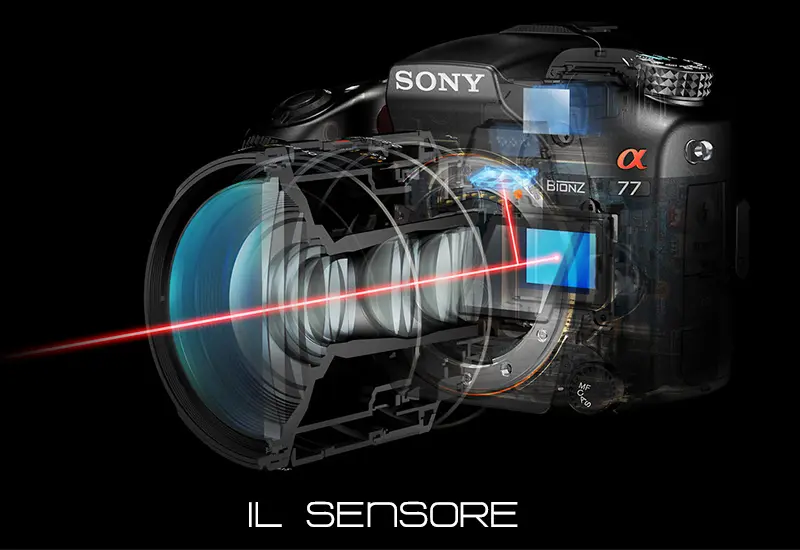
In this fourth lesson of the online photography course, we talk about one of the most important components of our camera: the sensor.
The sensor is a photosensitive medium that converts the light captured by the lens into an electric charge, translating it into electronic signals.
Before the advent of digital, this task was assigned to film, a photosensitive strip capable of preserving the captured image through a chemical process.
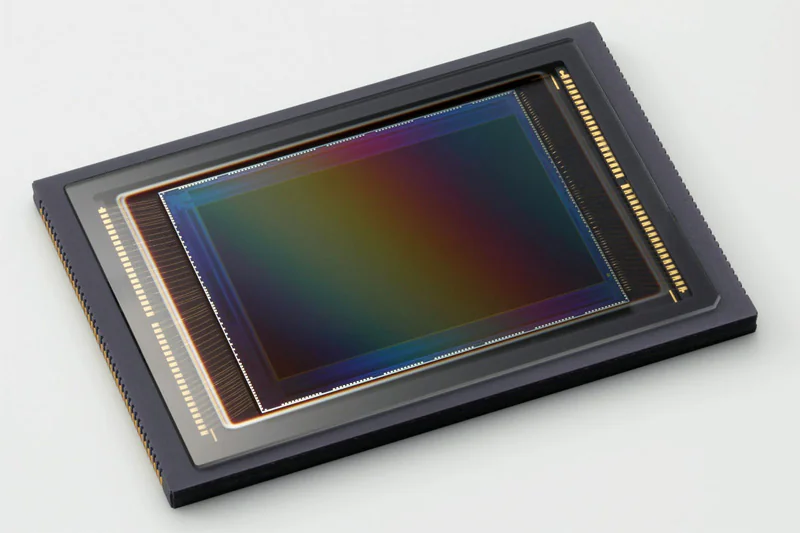
What is a digital sensor made of?
A digital sensor is a small rectangle, more or less large, of silicon packed with photodiodes and equipped with various necessary connections, both internal and to the rest of the camera components.
Photodiodes are light-sensitive devices capable of recognizing a specific wavelength and converting this event into an electrical signal (digital file). However, these photodiodes only “see” in black and white, or rather, they are not able to identify the color of the light they have stored.
How is it then possible that photos come out in color?
In front of the photodiodes (in the image below they would be the gray squares) is positioned a grid made up of many colored filters (Bayer), each with one of the three primary colors in the proportion 50% green, 25% red, 25% blue. Each single filter lets through only the light of its color!
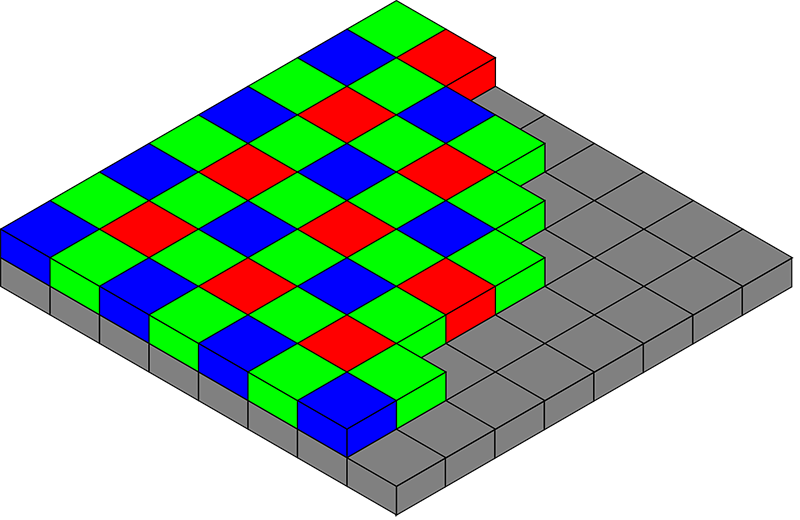
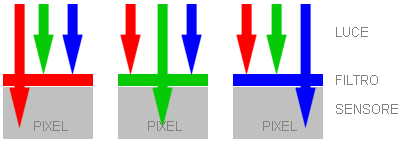
At this point, the camera’s processor applies an algorithm called “demosaicing” which takes as reference a grid of 4 elements (2 green, 1 blue, and 1 red) and, mixing the three primary colors, obtains information about the color.
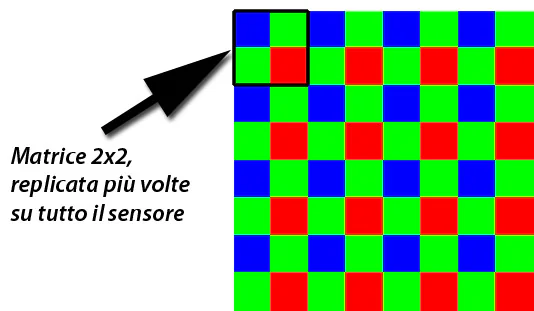
The pixel density on the sensor determines the megapixel value of the sensor itself.
Types of sensors currently on the market
The current sensors in circulation are divided into 2 technological families: CCD (charged coupled device) and CMOS (complementary metal oxide semiconductor).
Without going too much into detail, we can say that in CCD sensors each pixel charge is transferred to a limited number of nodes, converted into microvolts, and transferred in analog mode to the camera. In CMOS sensors instead, each pixel has its own charge conversion and the sensor itself has a signal amplifier, a noise reducer, and a digitization circuit. Therefore, the output signal is digital.
Each of the two technologies has strengths and weaknesses that make them suitable for certain applications and not for others. Summarizing, however, the main differences are:
- The CCD produces a higher quality image and lower noise level compared to CMOS
- The CCD consumes considerably more energy than the CMOS
- The CCD is more expensive
- The CMOS has greater complexity compared to the CCD
\t
\t
\t
\t
Today, sensors are comparable also because companies have continued to improve both types of sensors, aiming to enhance image quality for CMOS and to reduce power consumption for CCD.
Sensor Formats
Often when buying a camera, people only look at the number of megapixels, neglecting the importance of the sensor format. A high number of megapixels does not always correspond to high image quality.
It is no coincidence that full-frame cameras, which have a large 36x24mm sensor, guarantee better image quality and also less "noise" in low light. This is because a larger sensor corresponds to larger pixels that capture more light and deliver better performance. That is why small sensors (for example) with 8 megapixels take worse photos than large sensors with 4 megapixels.
That said, let's quickly summarize the main sensor formats currently on the market:
- FULL FRAME (full format), 36.0 x 24.0 mm, equivalent to the classic 35mm format of 24x36mm;
- APS-H, 28.7 x 19.1 mm, about 63% of full frame (1.3X crop factor);
- APS-C, 22.5 x 15.0 mm, about 38% of full frame (1.6X crop factor)
\t
\t
\t
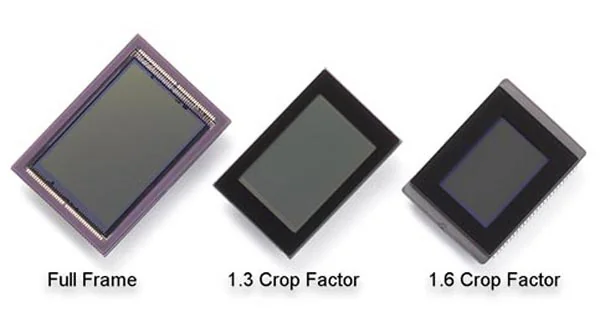
The sensor size is therefore a parameter ESSENTIAL to check when purchasing a new camera. Small sensors will hardly deliver acceptable results, while large sensors, even with fewer megapixels, will provide great satisfaction.
If you missed the previous lessons you can consult this page where there is a summary of all the lessons of the course.



