In these days of rain continuous and relentless, we thought to write this article to help you still go out of the house to enjoy photographing in the rain.
Photographing in the rain? Are you crazy? you might say... It's so nice and cozy at home, why should I go out?
Well yes, those who love photography know very well that rain and adverse weather conditions can create situations with fantastic atmospheres and generate shots full of suggestion and great charm.
Of course, some extra precautions are needed but in this article you will find all the right tips to get perfect shots even in the rain.
It's too easy to go out in August under full sun and take beautiful photos!!! Try taking your camera out during this autumn period with relentless rain. You will face gray skies, poor light, dull colors, and uninteresting subjects.
For this very reason, photographing in the rain will help you take a leap in quality and bring out all the creativity that is within you... provided you follow the tips you find below. Let's get started!!!
Find a way to protect yourself and your equipment
The first tip may seem obvious but the first thing to do when going out to photograph in the rain is to find a way to protect yourself and your equipment.
Nowadays, all (or almost all) cameras on the market are fairly waterproof and can handle a few raindrops well, but in the case of a heavy storm, it's always better not to test your camera's resistance and try to protect it as much as possible.
There are on the market some practical covers that completely wrap your camera leaving a front opening (to be able to take the photo, of course) and one at the back to insert your hands.
These covers are really very practical but obviously in the case of a heavy storm they are of little use; in this case, an umbrella would be better, although it is really inconvenient to take a photo with one hand busy holding the umbrella.
Use a high ISO sensitivity
When you try photographing in the rain, almost always the lighting conditions are really poor.
Even during the day, without sunlight and with the sky completely gray (if not black), there will always be very little light.
For this reason, the second tip we want to give you is to immediately increase the ISO sensitivity of your camera.
A brief note: if you are not familiar with ISO sensitivity and want to learn more, we remind you that we have dedicated an entire lesson of the photography course that you can reread at this address.
Increasing the ISO sensitivity will also help you maintain a high shutter speed to avoid the final photos being blurry.
Be careful not to overdo the ISO value, otherwise you risk getting too much "noise" in the final images, which will appear grainy and unpleasant to look at. Professional cameras handle very high ISOs well, while amateur cameras struggle more. A good ISO value to comfortably photograph in the rain is 800.
Try to keep a fast shutter speed
Rain is fast, actually very fast. Just like any other moving subject, if you want to capture all the beauty and essence of rain, you should try to keep a fast shutter speed.
Ideally, it would be 1/250 sec. But it will almost always be impossible to use this speed because the light is always low.
Start from this value and then go lower, but don't overdo it because beyond 1/60th of a second the photo will almost certainly be blurry.
Try to capture the feelings that rain evokes in people. You might see expressions of annoyance, sadness, or even joy and wonder in children. However, you must be quick, or you will miss the fleeting moment. Carpe diem!
Play with lights to create special effects
If you go out to photograph in the rain at night, go to the city center or a place where there are many light sources (headlights, traffic lights, signs).
These sources won't help you illuminate the scene or allow you to shoot at fast speeds, but they will serve as a background to create plays of blurred "light" that will give magic to the final image.
If you use a wide aperture, resulting in a shallow depth of field, you will have focus on the subject in the foreground while the "little lights" in the background will be all soft, as in the images below.
Take advantage of reflections
Another valuable tip for getting good results when photographing in the rain is definitely to look for reflections.
Rain creates puddles on the ground; use them to invert the world and add a touch of originality to your images.
It will certainly not be easy to focus on a subject reflected inside a puddle, but with a bit of practice you will see that you get great results.
Wait for the storm to end for a magical light and unmissable opportunities
Photographing in the rain is beautiful even afterwards, when everything has ended. Often, especially in summer, after the rain sun rays filter through that change the atmosphere around you; try to capture them quickly because they will disappear in a short time.
The colors change and suddenly become vivid. The effect of wetness on the street and on colorful objects will give that extra touch of magic that will make your images spectacular.
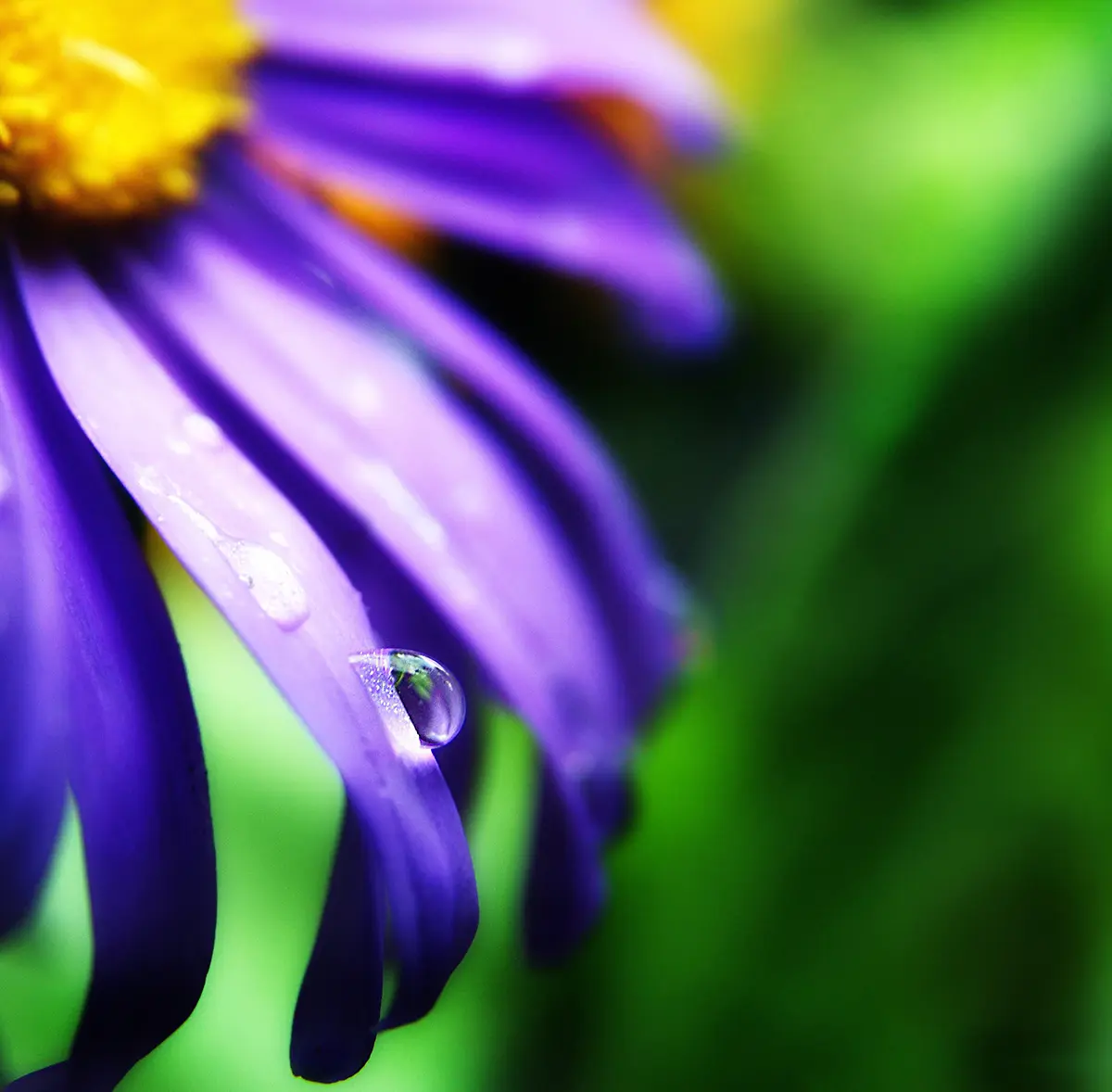
Focus also on small objects, mount a macro lens and go capture the infinite greatness of a simple drop of water on a leaf. It may seem trivial but if you find the right subject this drop will become the true protagonist of the shot.