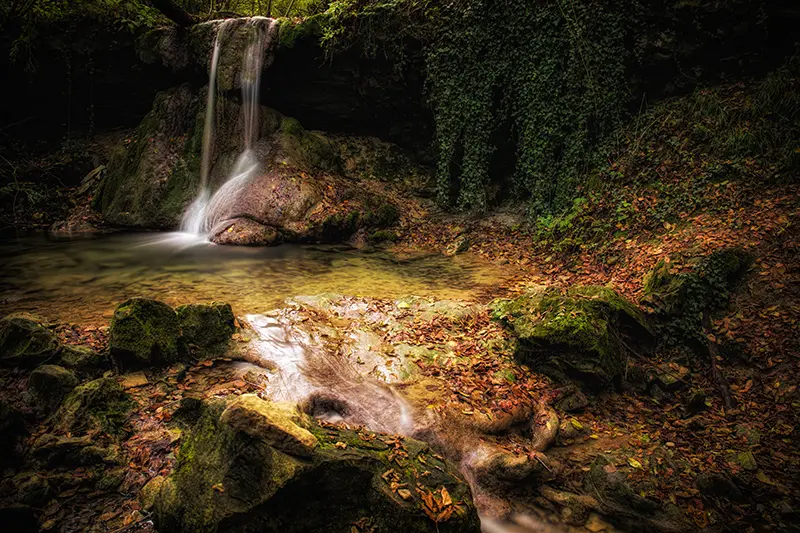
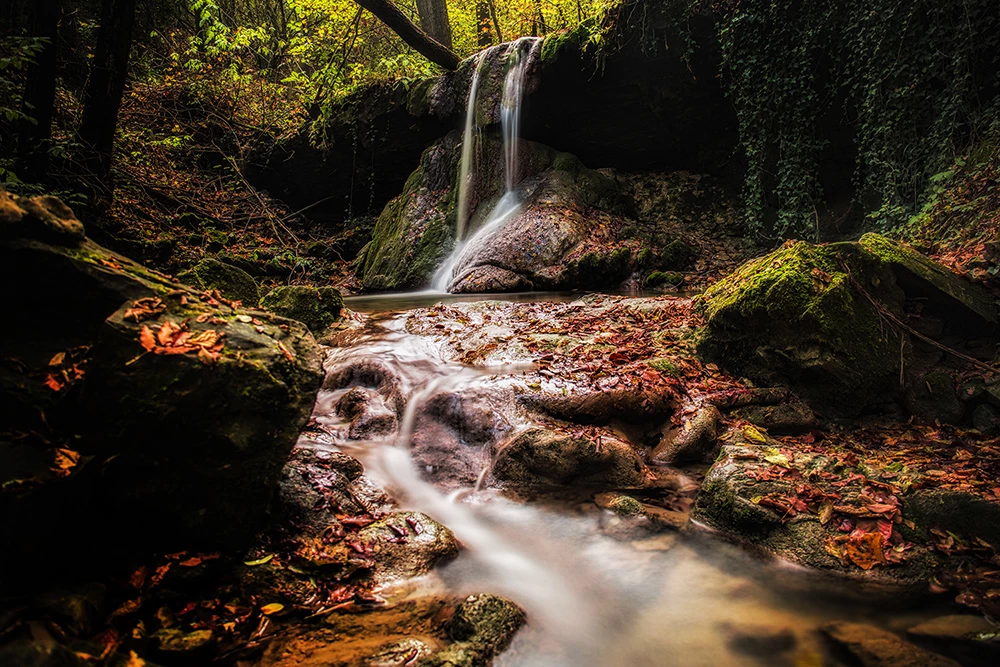
 It had been a long time since I went out for an intense photography day, and this weekend I took the opportunity to visit a magical place just a few kilometers from Modena: the Bucamante waterfalls. I had heard about it for a long time as one of the most beautiful and evocative routes of the Modenese Apenninesbut I had never had the chance to visit it.
I set off with all my photographic equipment (including tripod!) and suitable clothing, and after about 20 minutes by car from Modena I arrived at my destination. Once inside the woods, I followed a well-marked path that runs alongside the Bucamante stream until reaching, after about a 30-minute walk, the 2 main waterfalls.
Throughout the entire route, I witnessed the relentless autumn fall of leaves, the silence was incredible, and the morning fog helped make everything extremely magical and evocative. Never before on a walk had I felt like I was facing gnomes and sprites, I was alone in this valley but I was sure I had eyes on me.
I am convinced that if they were to shoot a fantasy film in my city, they would definitely choose the Bucamante waterfalls as the location! It was a beautiful day, a fairy-tale experience that I recommend everyone to live, preferably in autumn and with fog, the colors are amazing.
BRIEF HISTORY
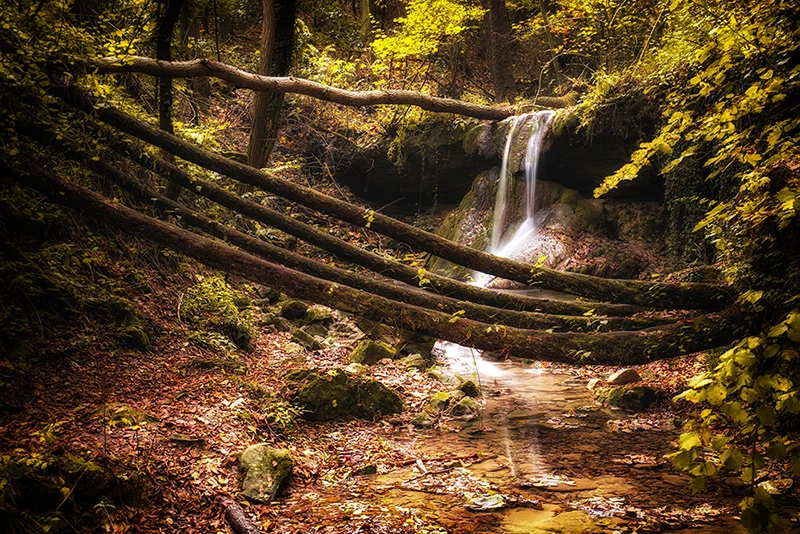
The sources of the Rio Bucamante spring from the hills of Serramazzoni. The stream's course forms in the gorge between Monte di Monfestino to the West and Monte Corazzano to the East. It is a limestone area, so the waters along the path deposit Calcium Carbonate concretions which, over time, transform into Travertine. In the four large waterfalls and the smaller cascades, stalactites (in some they are clearly visible). Along the water's path, traces of an ancient travertine quarry can be seen.
The largest waterfall is named “BUCAMANTE”. Legend has it that the name derives from the Lovers' Hole (BUSAMANTE) and tells the tragic story of the shepherd Titiro and the noble lady Odina. She was beautiful, young, blonde and used to take long walks in the woods accompanied by her maid, and it was on one of these walks that she met the young shepherd Titiro, who was also very handsome.
The two fell in love and then met in secret, but one day the jealous maid told everything to Odina's parents, who locked their daughter in the castle. However, Odina managed to escape and reached Titiro, but it wasn't long before they heard the voices of the servants in the distance, so, realizing their love would end, they threw themselves from the Bucamante waterfalls, in a tender embrace that would unite them for eternity.
In 2003, the Rio Bucamante had the merit of giving us another beautiful waterfall. Fully rediscovered (because it was covered and hidden by very dense vegetation) by the naturalist ROMANO TERMANINI who, together with a few friends, helped bring this splendor back to light.
Because of its soft moss, the waterfall is called, THE MOSSY. Above this waterfall there are two other small cascades with numerous “NATURAL POOLS” called “Le Travertine” formed by the flowing water and the limestone deposits. In ancient times, the waters were certainly more abundant and frequent, hence the need for various mills and aqueducts to supply the various villages (Riccò Vecchio, formerly Ricovium because it was a refuge for travelers on their way to Rome).
For visitors, reaching the Bucamante Waterfalls is easy. Coming from the Nuova Estense, exit at Pazzano, from Granarolo (the name of this village in this area comes from an ancient granary that probably served as a reserve during times of famine) you follow the path along the stream.
From Cornazzano, descending the trails from above the “VASCHETTE” and the “MUSCHIOSA.” Another path, through the woods, starts from Monfestino (once the ancient capital. The medieval village, the castle, and the church are well preserved). The Rio Bucamante trail needs care, with regular and constant maintenance. This is possible thanks to the diligent and loving care of some volunteers.
ITS HABITAT
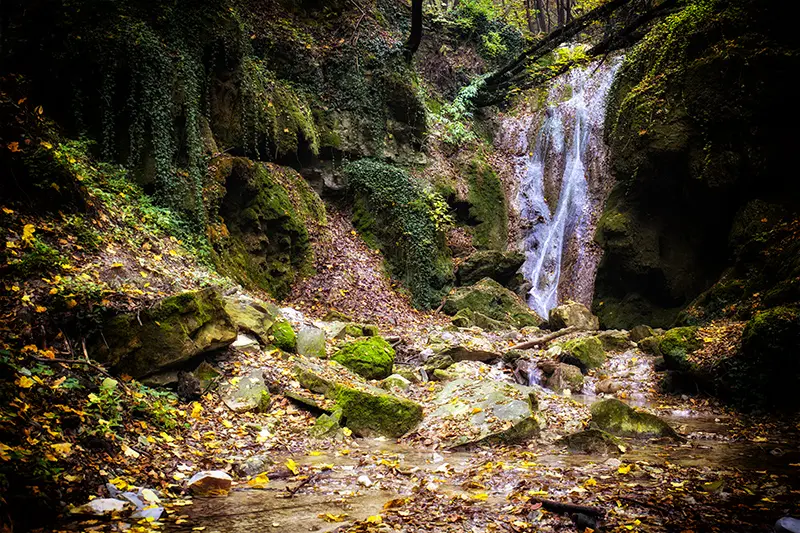
Along the Bucamante path, numerous plant species live, many of which are hygrophilous, along with animal species.
TREES: Turkey oak, Oak, Sweet broom, Hazel, Dogwood, Chestnut, Willow, Ash, Hornbeam, Black locust, Poplar, some Alder, Medlar, Rowan, etc.
SHRUBS: Tanners' broom, Hawthorn, Dog rose, Viburnum, Broom, Clematis vitalba, Elder, Dogwood, Blackthorn, etc.
FLORAL SPECIES: Peony, Wood anemone, various types of Orchids, Ferns, Solomon's seal, Martagon lily, Liverwort, Lungwort, Horsetail, Hellebore, various mosses, Leucojum vernum, Crocuses, Gentiana asclepiadea, Arum, Asarum, Actaea spicata….
VARIOUS FAUNA: River crayfish, Tree frog, Common toad, Green lizard, Lizard, Hedgehog, Aesculapian snake, Grass snake, Badger, Wild boar, Beech marten, Porcupine, Roe deer, Squirrel, Dormouse, Fox, Weasel, Hare, Vole, Edible dormouse, Shrew, Hoopoe, Coal tit, Blue tit, Great tit, Firecrest, Wren, Magpie, Jay, Crow, Falcon, Buzzard, Kestrel, Honey buzzard, Blackbird, Oriole, Robin, Grey heron, Owl, Tawny owl, Scops owl, Little owl, Great spotted woodpecker, Green woodpecker, etc.