
In this article we will look at the most surprising scientific images that have captured the attention of the journalists of Nature, one of the oldest and most important scientific journals in existence, perhaps the most prestigious within the international scientific community. It has been published since November 4, 1869.
Although most journals in the field are now highly specialized, Nature is one of the few publications, along with other monthlies such as Science and Proceedings of the National Academy of Sciences, that still publishes original articles across various scientific fields. Let's not waste time chatting and enjoy the best scientific images of 2019.
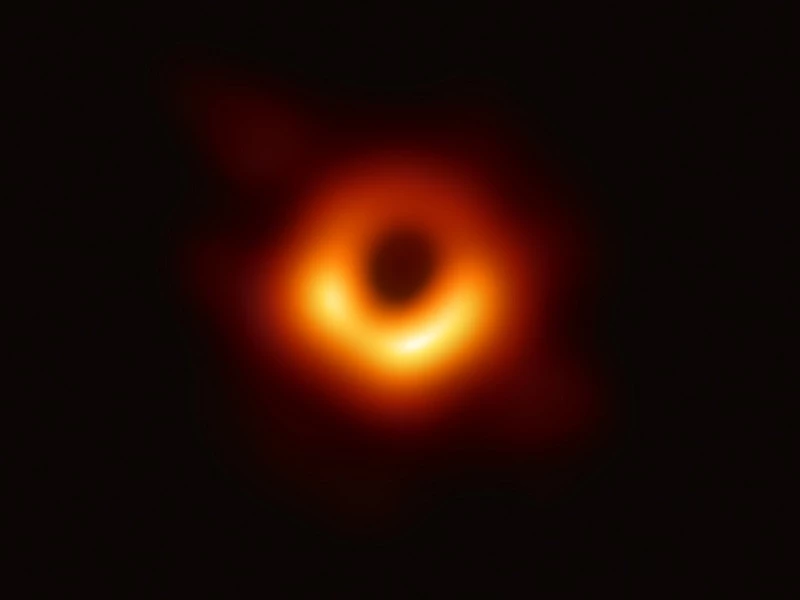
The first photo of a black hole
The Event Horizon Telescope Collaboration unveiled in April the first direct image of a black hole and its event horizon. The team used eight radio observatories to capture the ring of light around the black hole at the center of the Messier 87 galaxy. (© ETH Collaboration)
Thin ice
This aerial view of sea ice in eastern Greenland was captured by photographer Florian Ledoux using a drone. Low levels of winter snow cover, heat waves in spring, and a sunny summer contributed in 2019 to significantly melting the ice cover in Greenland. (© Florian Ledoux)
Circle of cells
Each small dot in this circle represents one of about 100,000 rhesus macaque cells. Cells with similar traits cluster together, and each color represents different tissues such as the thymus and lymph nodes (blue) and bone marrow (red). (© Carly Ziegler, Alex Shalek, Shaina Carroll (MIT) and Leslie Kean, Victor Tkachev and Lucrezia Colonna (Dana-Farber Cancer Institute)/Wellcome Photography Prize 2019)
Go with the flow
French researchers have carved a labyrinth of microfluidic chambers into a silicon wafer to simulate blood circulation. Biophysicist Benoît Charlot from the University of Montpellier captured this image using a scanning electron microscope. (© Benoit Charlot/CNRS/IES Univ. Montpellier/Labex NUMEV)
Little trumpets
Stentorids are a group of freshwater unicellular protozoa. This image won second prize at the Nikon Small World Photomicrography Competition 2019, and was taken by researcher Igor Siwanowicz, magnified 40 times, at the Janelia Research Campus of the Howard Hughes Medical Institute in Ashburn, Virginia. (© Dr. Igor Siwanowicz)
Honey hunters
Lizzy Brown (media editor-in-chief). This incredible image of honey gatherers dangling precariously from the edge of a cliff, surrounded by bees and smoke, caught my attention. The gatherers, who live in southern China and belong to the Lisu ethnic group, risk their lives to collect precious honey from bee hives. Although they are careful not to harvest too much honey at once, this traditional practice is threatened by declining bee populations due to heavy pesticide use and global warming. (© Kevin Frayer/Getty)
The seal's nap
Jessica Hallett (associate media editor). "Sleeping like a Weddell" was my favorite image from this year's Wildlife Photographer of the Year competition, organized by the Natural History Museum in London. After seeing thousands of heartbreaking images of climate change, destruction, and devastation, discovering this photo of a Weddell seal — an image expressing peace and innocence — was a breath of fresh air. It inspired me and rekindled my passion for our natural world. (© Ralf Schneider)
Tiny drama
This net-like microstructure is made of fats left behind after researchers evaporated a 1 microliter drop of diluted bourbon whiskey. Fats dissolve in high-proof alcoholic drinks but cause the liquid to become cloudy when water is added. (© Stuart J. Williams)
Is anyone home?
A fish explores a bleached sea anemone in the Red Sea, off the coast of Saudi Arabia. Like corals, anemones form symbiotic relationships with algae, which break down when oceans become too warm. The anemones expel the algae and become colorless. (© Morgan Bennet Smith)
Brave ones
Petronella Chigumbura is part of Akashinga, or "the brave ones," an all-female anti-poaching unit patrolling the Phundundu Wildlife Area in Phundundu, Zambezi, where elephant poaching is common. (© Brent Stirton/Getty)
Good vibrations
This false-color image shows shock waves produced by the US supersonic T-38 Talon aircraft, and was taken by NASA staff from an overhead plane using an experimental technique. It shows rapid changes in air pressure responsible for sonic booms. The data will help aerospace engineers design quieter supersonic aircraft. (©NASA)
Out of the shell
This fluorescent visualization of a turtle embryo won the Nikon Small World Photomicrography Competition 2019. Teresa Zgoda and Teresa Kugler collected and merged hundreds of stereomicroscopic images of an embryo about 2.5 centimeters long. (© Teresa Zgoda and Teresa Kugler)
Space women
Astronaut Christina Koch took this photo of the Soyuz spacecraft carrying her NASA colleague Jessica Meir as it approached the International Space Station (ISS). On October 18, the two astronauts conducted the first all-female spacewalk to repair a faulty battery on the ISS. (© Christina Koch/NASA)



