
The opposite of "movement" is calm total, the tranquility. Today we return to discussing photographic composition and we do so precisely by talking about how the horizontal lines within the frame give the viewer a sense of total calm.
Horizontal lines are the fundamental reading base in photographic composition, our visual system is used to observing anything starting from objects placed horizontally, also because it is easier for our eyes to scan the image from left to right (or the opposite depending on the culture we belong to).
Among the horizontal lines there is one present in all landscape photos. I am obviously talking about the horizon. The horizon is the first guideline we look for in a landscape photograph and it mainly serves to clearly divide the image.
Among the many rules that "should" be respected in photography, there is one that is fundamental: the horizon line, when present, MUST BE STRAIGHT!!! This is because a horizontal line that tilts to one side will give you an extreme sense of instability. Try it to believe it: take a photo of the sea with a crooked horizon and then tell me what you think, it makes me seasick!

Horizontal lines and the rule of thirds
To significantly improve photographic composition and the final result, try to apply the rule of thirds (we discussed it fully in a course lesson).
This compositional rule divides the frame with a hypothetical virtual grid that will split your frame into 9 sections.
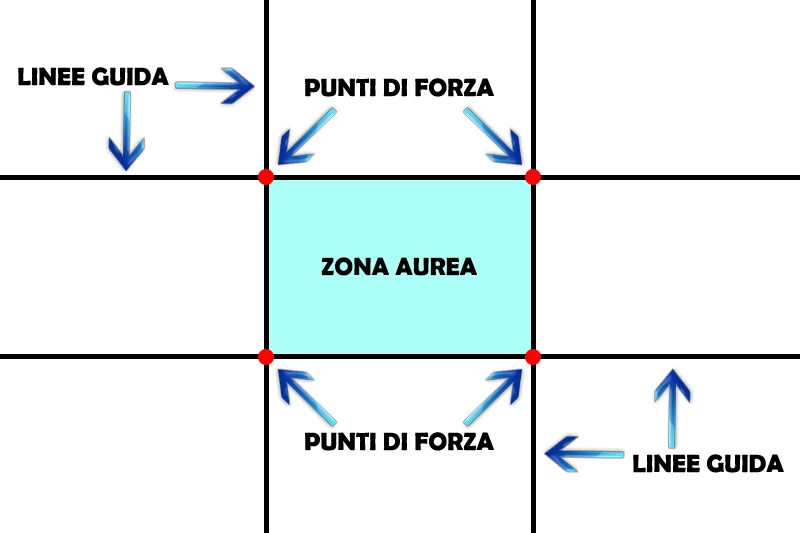
Leaving aside the golden ratio and the points of strength, focus on the horizontal lines of this grid and try to position the horizon in front of you (or any horizontal line present in the frame) on one of these 2 lines. In short: NEVER place the horizon in the center of the image to avoid making it banal, position it at 1/3 above or 1/3 below.
At this point you might be wondering whether it’s better to align the horizon with the top or bottom line. A perfectly reasonable question! There is no precise answer, it depends on what you want to emphasize more in your image.
If you are photographing a stormy sky full of clouds, it’s better to align the horizon line with the lower guideline, framing 2/3 sky and 1/3 land, giving much more importance to the clouds. Conversely, if the sky in front of you is free of clouds or interesting elements, you should align the horizon line with the upper guideline, giving more importance to the land.

It may seem absurd, but horizontal lines in photographic composition also serve to convey tranquility to the viewer.
This is because our brain is used to seeing any object subject to the force of gravity. Horizontal lines in a static image act as a support plane to counteract gravity and reassure the viewer (unlike vertical lines which cause dizziness)
Conclusions
Horizontal guidelines, along with all the others, are the most powerful photographic composition tools at our disposal. If used correctly, they can help you convey your message to the viewer in a simple and intuitive way.
Use horizontal guidelines horizontal if you want to convey stability, calm, and tranquility. I understand it’s not that simple, but as I often remind, my advice remains the same: shoot, discard the photo, and shoot again. Only with practice will you start to find horizontal lines everywhere!



