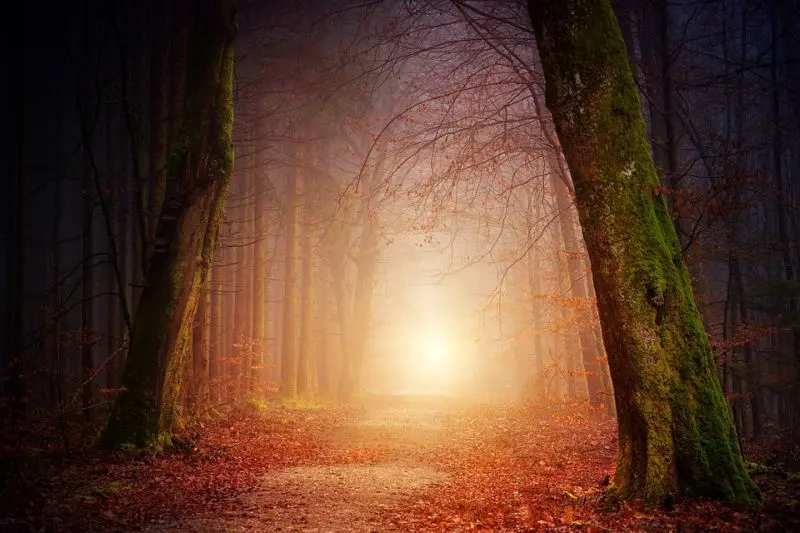
A photograph is made of light and color. These are the only two ingredients. Knowing how to skillfully balance them allows you to go from a bad or ordinary photograph to a fantastic image.
Understanding light is therefore necessary for a photographer to best express their idea and move from a simple representation of reality to something creative.
To understand light, you don't need a degree in physics, but a bit of scientific knowledge will allow you to express yourself better.
Light
Light has incredible properties: it carries energy, behaves like a particle under certain conditions, and like a wave under others. More precisely, the term light refers to the portion of the electromagnetic spectrum that is perceivable by the human eye (which is a small part of the spectrum).
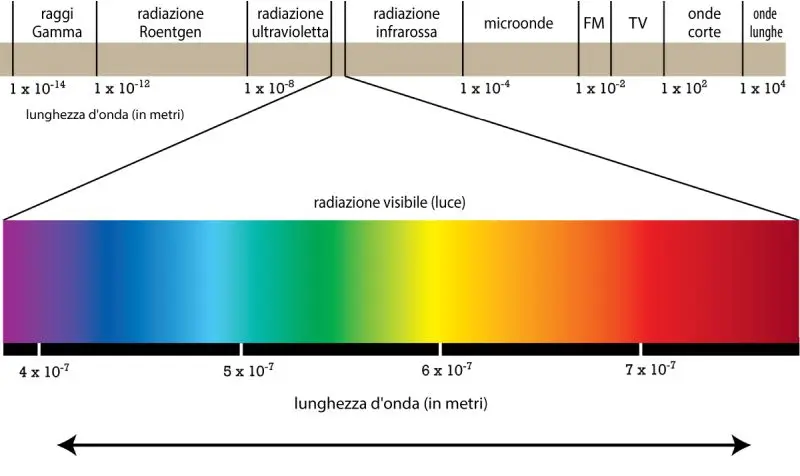
Different wavelengths are interpreted as colors, from red (with longer wavelengths) to violet (with shorter wavelengths). Some cameras are designed to see a broader spectrum, for example in infrared photography. From a photographic point of view, the properties of light that interest us are:
- amount of light that hits our subject;
- quality of light, which can be diffused (with soft or nonexistent shadows) or hard (with a sharp and clear cut between lit and dark areas);
- color of light, which can be varied by placing colored filters between the light source and the subject;
- direction from which the light comes. Light travels only in a straight line, but it can be redirected using a reflector. In this case, the light can also be “colored” by using a reflector of a non-neutral color (for example, gold). One must also take into account unwanted reflected light, for example from a colored wall near the subject.
Photography, Light and Colors
We know that without light there is no photography. General photography works within the visible light spectrum. We use the scale of Kelvin temperature to describe the color of light. For example, the flame of a candle is at 1,200 K, which is toward the red-orange end of the scale, and a clear day is at 10,000 K, which is at the blue end.

White balance
The human brain is good at correcting colors. For this reason, even if illuminated by colored light, we know that the central band of the Italian flag is white. Unfortunately, this is not the case for cameras. Their “brain,” even if powerful, cannot perform such a simple task.
For this reason, there is the white balance: we can tell the camera that captured an image using the available light (sunlight, neon, tungsten, etc.) what it should consider white and thus use it as a reference for the other colors.
With white balance, we therefore correct the colors recorded by our camera.
For this reason, it is important to shoot in RAW format because it is possible to make this correction without loss of information. However, be careful when performing color correction. In some cases, it is better to have a “wrong” color that creates an atmosphere, rather than a correct color that causes the image’s meaning to be lost.
For example, a subject illuminated by candlelight has a warm tone that creates atmosphere, which would probably be lost by applying excessive white balance correction.
RGB
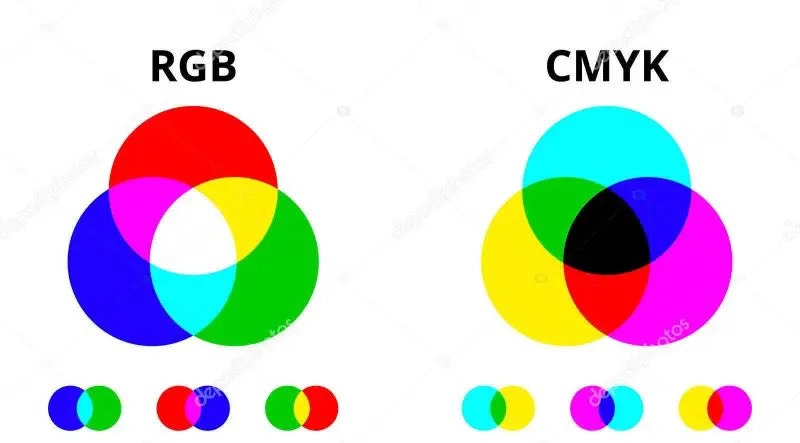
Cameras can represent all colors, but in reality the photosensor is designed to record only the three primary colors: red (Red), green (Green) and blue (Blue).
All other colors are obtained by combining these three primary colors: yellow = green + red, cyan = green + blue, magenta = red + blue, and so on up to white = red + green + blue.
Since different colors are formed by adding other colors, the RGB color model can be defined as additive (note: black is formed by the total absence of these colors).
Each color has 255 levels of variation, so we can identify pure red as 255, 0, 0, white as 255, 255, 255, and black as 0, 0, 0. In this way, pure yellow can be identified as 255, 255, 0 and a deep purple as 113, 58, 210.
CMYK
The RGB model works perfectly on cameras and monitors where we add light to black to create color. When printing, however, we start with a piece of white paper and subtract from that white to create color.
Instead of red, green, and blue as primary colors, printers use cyan, the magenta, the yellow and the black (CMYK) to create all the other colors. “K” is used for black because it is the last letter of the word (blacK) and is not used by any other color.
To save on ink costs and to produce deeper shades of black, unsaturated and dark colors are created by adding black ink rather than only using the combination of cyan, magenta, and yellow.
So, while in the RGB model, pure red is defined as 255, 0, 0, the exact same color in the CMYK ink printing world is something like 0, 100, 100, 0.
How Photographers Control Light
As photographers, we must manipulate light to create our image. If we work in a studio, it is quite simple since we have all the equipment available: light sources whose intensity, color, and direction we control, reflectors to illuminate shadowed areas and thus soften them more or less decisively, screens more or less translucent to diffuse light or create shadows exactly where we want them.
When we are outdoors, we have fewer control options, especially in landscape photography. In that case, we can only rely on nature: more or less cloudy skies and shooting during the golden hour are definitely the simplest tricks to use.
Conclusion
Learning how light works is fundamental for a photographer. Understanding how direct or diffused light, the time of day and season, the direction and angle of incidence, factors such as artificial or natural screens and diffusers (fog, smoke, rain, ...) all influence how the camera perceives light is essential for a photographer. Learning to see light is the secret to achieving incredible photographs.