
To improve in everything you do in daily life, it is necessary practice, practice and more practice. Also regarding photographic activity, a constant practice is necessary to reach higher levels.
If we apply ourselves consistently, 365 days (and this is the challenge) are necessary to improve as photographers.
So let's see some tips that, if applied consistently, will allow us to become better photographers in just one year.
Check your settings every time you turn on the camera
I'm the first who needs to follow this advice! Who has never started a photo session only to realize the settings were left as they were last time?
This is a good way to get disasters! Since every photo session is different from the others it is (almost) impossible to use the settings used previously for a new shoot, especially if shooting in manual mode.
The first thing to do, as soon as you turn on the camera, is to define the settings you intend to use during that specific photo session: RAW format, manual mode or aperture priority, ISO (100 to start, but you can raise it if ambient light is low), average exposure metering mode (or spot if you are starting a portrait session), AF-S focus mode (which allows you to lock focus by half-pressing the shutter button).

Checking your camera settings is easy. It takes 60 seconds, tops. So you just need to get into the habit of remembering to do it!
Check around your subject before taking every photo
You’ve framed your shot, you’re ready to shoot, but have you looked at what’s around your subject? Are there distracting elements? People or vehicles, streetlights or utility poles, leaves or branches where there shouldn’t be any?
A quick check takes no more than a couple of seconds: make sure there are no distractions!
Look for the best light
One of the easiest mistakes to make in photography? Shooting in poor lighting. In fact, bad light is probably the number one culprit behind dull images.
Because bad light can turn a beautiful composition into something shapeless. That’s why you should get into the habit of shooting only with the best light.

But what does the best light mean? It somewhat depends on your photography genre. But if you’re shooting landscapes or outdoors, it’s pretty hard to go wrong with golden hour lighting (check out our tips here for making the most of golden hour).
Another good light is what you get when the sky is cloudy because diffused light is great for bringing out colors.
Shoot from different angles to improve your vision
It’s easy to get stuck in a single creative path, never trying different angles. This way, you miss out on so many potential great shots, so many different ways to express your creativity!
So, when you approach a subject, go ahead and take the standard front-on shot. Sometimes that can look good, after all!
But then look for unusual angles. Try to find a different viewpoint: from above and below, move around the subject every time you take a shot.
Use the rule of thirds
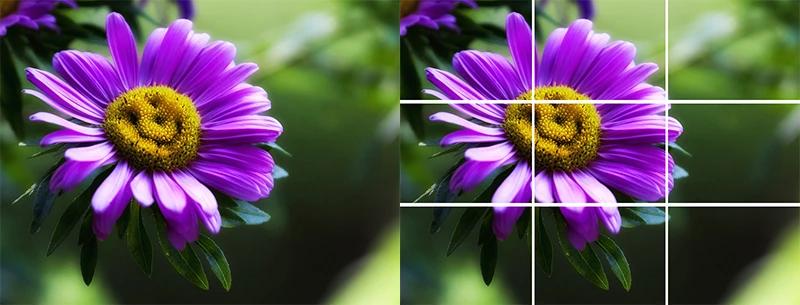
The rule of thirds it is a basic guideline on composition. In particular, you should try to place the main subject at the four intersection points on the grid. If you missed the photography course lesson where I talk about this rule, be sure to give it a read.
Now, the rule of thirds is not a rigid composition law. You can break the rule of thirds. And sometimes you can create truly unique photos by being willing to break the rule of thirds. But the rule of thirds is a great starting point for all your compositions.
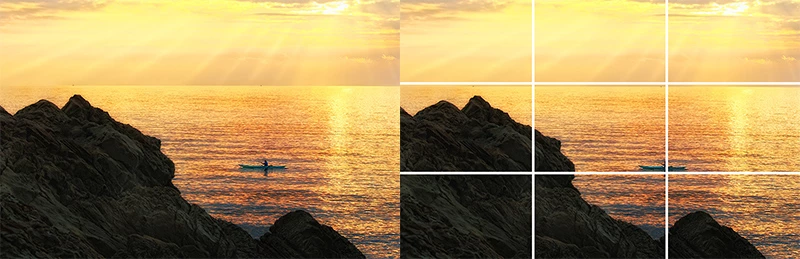
So, get into the habit of using the rule of thirds to start your compositions. Ask yourself: how can I align the elements of this photo with the thirds grid rule? If in the end you don’t use the rule of thirds for that photo, that’s fine.
But if at least you consider the rule of thirds before breaking it, your compositions will improve quickly.
Edit all your good photos
A bit of post-processing can make “ordinary” photos excellent. You don’t have to be a Photoshop or Lightroom guru to do this, the essentials are enough: adjust contrast and adjust colors.
First, you need to adjust the contrast. Most photos can benefit from a significant increase in contrast, so try it on your photos to see how it looks.
Second, you should adjust the colors. Simply increase the saturation colors that are not yet saturated. After that, you can continue to make other adjustments, reduce noise, and increase sharpness, etc. But it is not necessary. Just a bit of contrast and a bit of color can do a lot.
Take a picture every day to improve your photography skills
Currently you take a photo every day? This is difficult, especially if you have to dedicate yourself primarily to family and work.
Improving requires a consistent activity that opens the mind and stimulates the brain to produce always new different visions: I am sure you will start to see compositions where you had never seen any before and perceive light in a very different way.

It is not necessary to always use a DSLR, even the smartphones is enough for this exercise. It only serves to keep your photographic brain.
Look at beautiful photos every day
This exercise is the simplest: look at beautiful photos every day! The more good photos you look at, the more you develop your sense of color, composition, and lighting. You will start to notice how other photographers use the rule of thirds.
You will start to notice how photographers use contrasting colors very effectively. You will start to notice how different angles give a different look. And then you will start to notice how you can use these techniques in your photography.
Nowadays, it is not difficult to look at extraordinary photos. You can subscribe to the Instagram feeds of great photographers. You can join high-quality Facebook groups.
The key is to make sure you look at beautiful photos every day, no matter which ones. Improving this way is really very simple!
Conclusions
All that's left is for you to start implementing these suggestions in your daily life so you can completely improve your photography in a year. None of them are difficult. They take just a few minutes at most. But think about it again in a year and you'll be glad you started them.



