
How AI and Augmented Reality are Changing the Way We Learn Photography
Have you ever wondered how technology can revolutionize the way students learn photography?
And have you ever wondered what would happen if art education could become as interactive as using a simple app on your smartphone?
Or, even, what would a lesson be like where the camera “talks” to you and suggests how to improve a shot in real time?
Questions like these open scenarios that seem more like science fiction than a traditional classroom, yet they are becoming real much faster than expected.
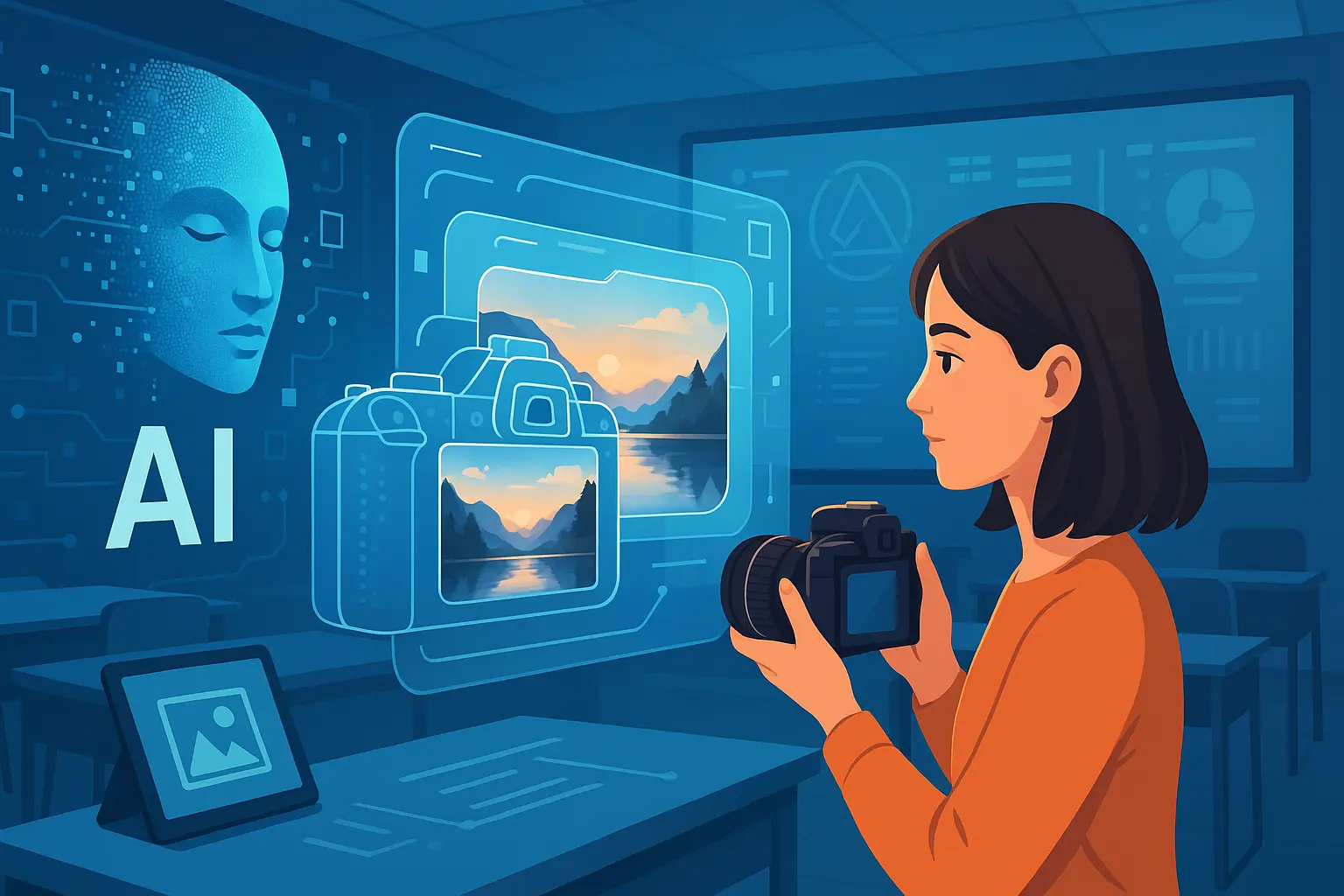
From traditional classrooms to smart classrooms
Today lessons no longer take place just in front of a blackboard, but in environments that resemble more a technology lab: tablets, interactive projections, AR headsets, and AI tools are entering art education with the same naturalness with which we now use Google Maps to navigate.
The problem is that often an essential element is still missing: natural interactivity, the kind that makes you learn because you “see and touch” the result, just like when you try a new recipe and understand if you’re making a mistake simply by watching how the dough behaves.
In photography, this type of immediate feedback is fundamental.
Where the union of AI and AR comes into play
And it is precisely here that artificial intelligence and augmented reality change the rules of the game.
A recent study analyzed how educational videos and AR apps can engage students in photography much more than traditional methods.
Imagine framing a landscape with your camera and seeing virtual guidelines appear before your eyes that explain how to improve the composition. It’s like having a teacher beside you, but without feeling watched or judged.
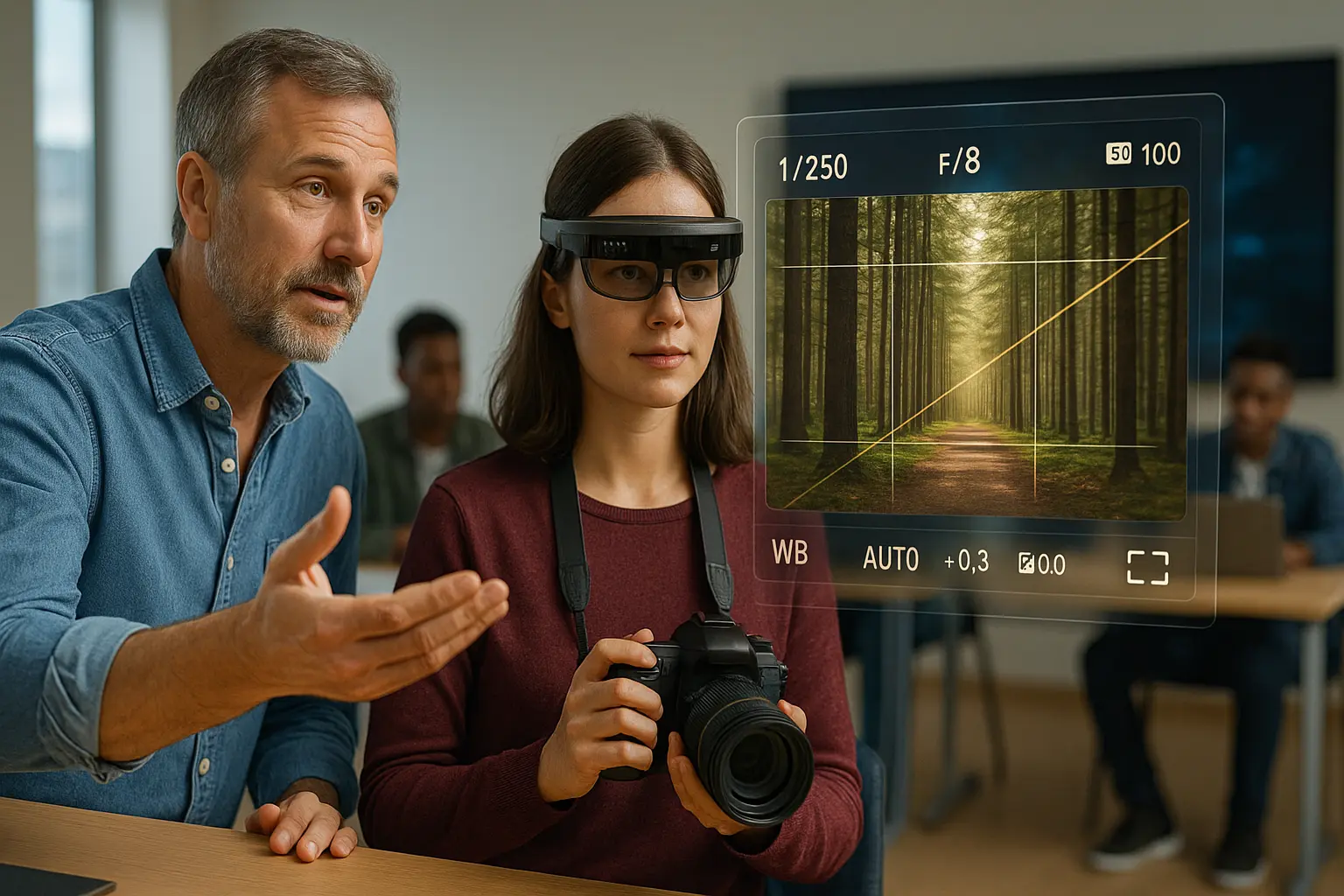
The technological core: an algorithm that “understands” images
Thanks to TensorFlow, a DRNN (Deep Recurrent Neural Network) algorithm has been developed capable of:
analyze the composition in real time,
suggest changes,
evaluate the shot with an almost “human” precision.
We are talking about an accuracy of 97,18%.
To give you an idea: it’s like having an assistant tell you at the supermarket which products are fresh with almost total accuracy, saving you any doubt.
The students’ reaction
The students involved appreciated the immersive experience: AR headsets, smart suggestions, and a new way of seeing photography increased the curiosity, the visual awareness and also the understanding of different cultures through images.
It’s not just a “cool tech thing”: it becomes a way to learn to observe, express yourself, and understand the world.
Advantages and risks of this revolution
Like every innovation, the combination of AI and AR brings bright sides… and some shadows.
Advantages
Immediate feedback: AI corrects in real time like a tutor always present.
Greater engagement: augmented reality transforms studying into a practical and dynamic experience.
Inclusivity: students with different learning styles find their own pace thanks to personalized suggestions.
Less “abstract” theory: everything becomes concrete, visible, practical.
Risks
Dependence on technology: if we rely too much on AI, we risk dulling our artistic sensitivity.
Reduction of creativity: following the “perfect rules” can make us lose the taste for mistakes that often lead to discoveries.
Limited accessibility: not all schools have the budgets for advanced smart classrooms.
Privacy and data: cameras, apps, and real-time analysis mean data collection, and this must be managed carefully.
Towards a new way of learning
In a time when technology grows faster than our habits, it is fascinating to imagine how AI and AR can open new paths in art education.
They will never replace the human eye or the photographer’s sensitivity, but they can become valuable tools to guide learners and amplify the creative process.
If you also feel that the future of photography goes through here, share this article with the Camera Nation community.
It’s the perfect time to explore new ideas, experiment, and let ourselves be inspired by an increasingly connected world — without forgetting that, in the end, the most important photo is always the one we take ourselves.



