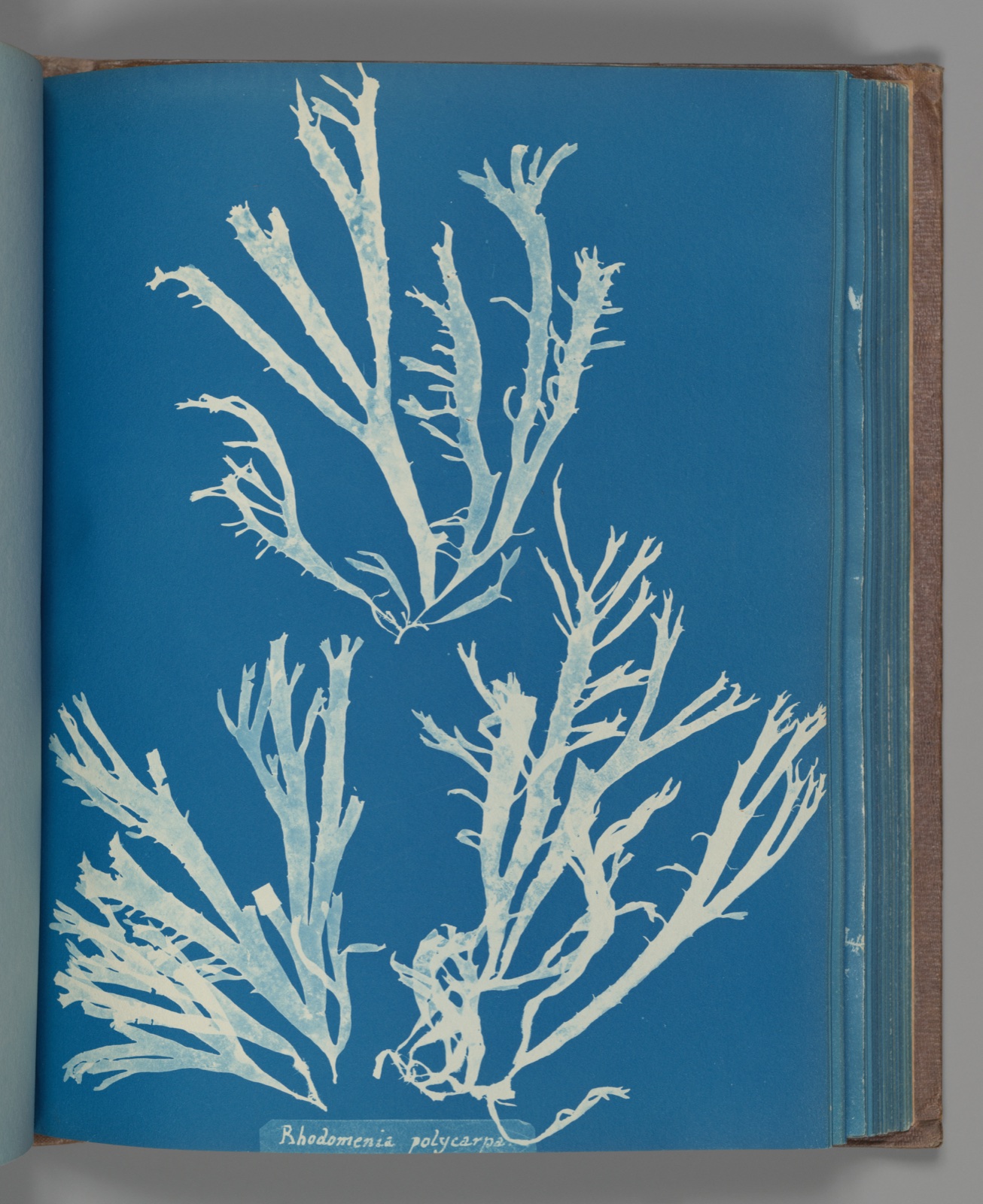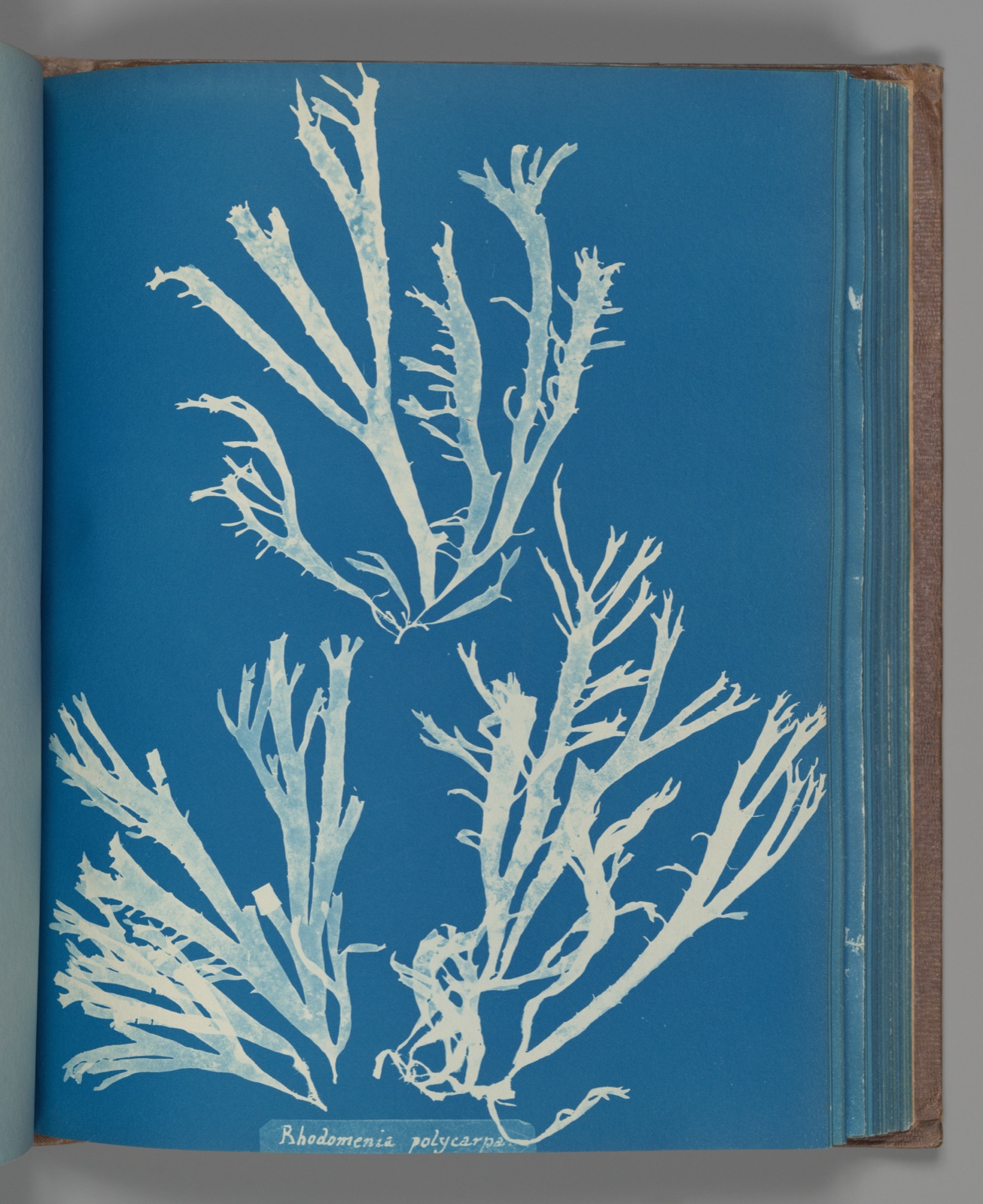
At first glance, the page seems almost impossibly simple: a pale branching shape against a field of blue. There is no horizon to locate it, no surrounding scene and no camera viewpoint in the usual sense. Yet Anna Atkins’s botanical cyanotypes ask a remarkably rich question. How much can a photograph communicate when its subject is placed directly against the paper that will record it?
Atkins, who lived from 1799 to 1871, belongs to the early history of photography and to the history of observing nature. Looking at her work today is useful for reasons that go beyond celebrating a pioneer. Her pages offer a lesson in the relationship between evidence and arrangement, and in how a sequence of pictures can become a way of thinking.
A photographer with a naturalist’s purpose
Atkins’s botanical interests were established before her photographic publishing. The Natural History Museum describes her scientific education, her work as an illustrator and her participation in networks through which specimens and ideas circulated. That context matters: the cyanotypes were not isolated decorative experiments made by someone encountering plants for the first time.
Her project also depended on access to education, materials and people. The familiar story of the solitary inventor is a poor fit for a practice that involves collecting, identifying, exchanging and publishing. It is more interesting to ask how these different activities support each other. A label depends on knowledge; a specimen depends on finding and preserving; a book depends on patient repetition.
Why the blue is more than a signature colour
The cyanotype process, introduced by John Herschel in 1842, makes images using light-sensitive iron compounds. In a botanical photogram, an object is placed directly on prepared paper and exposed to light; washing develops the recognisable blue-and-pale result. Atkins applied this camera-less method to algae.
That direct relationship between subject and surface changes what we see. A conventional photograph translates a three-dimensional scene through a lens. Here, contact, overlap and the passage of light become central. The specimen is not simply represented against a background: it participates in making the image. The blue is therefore evidence of a process, not a colour added afterwards to make the result attractive.
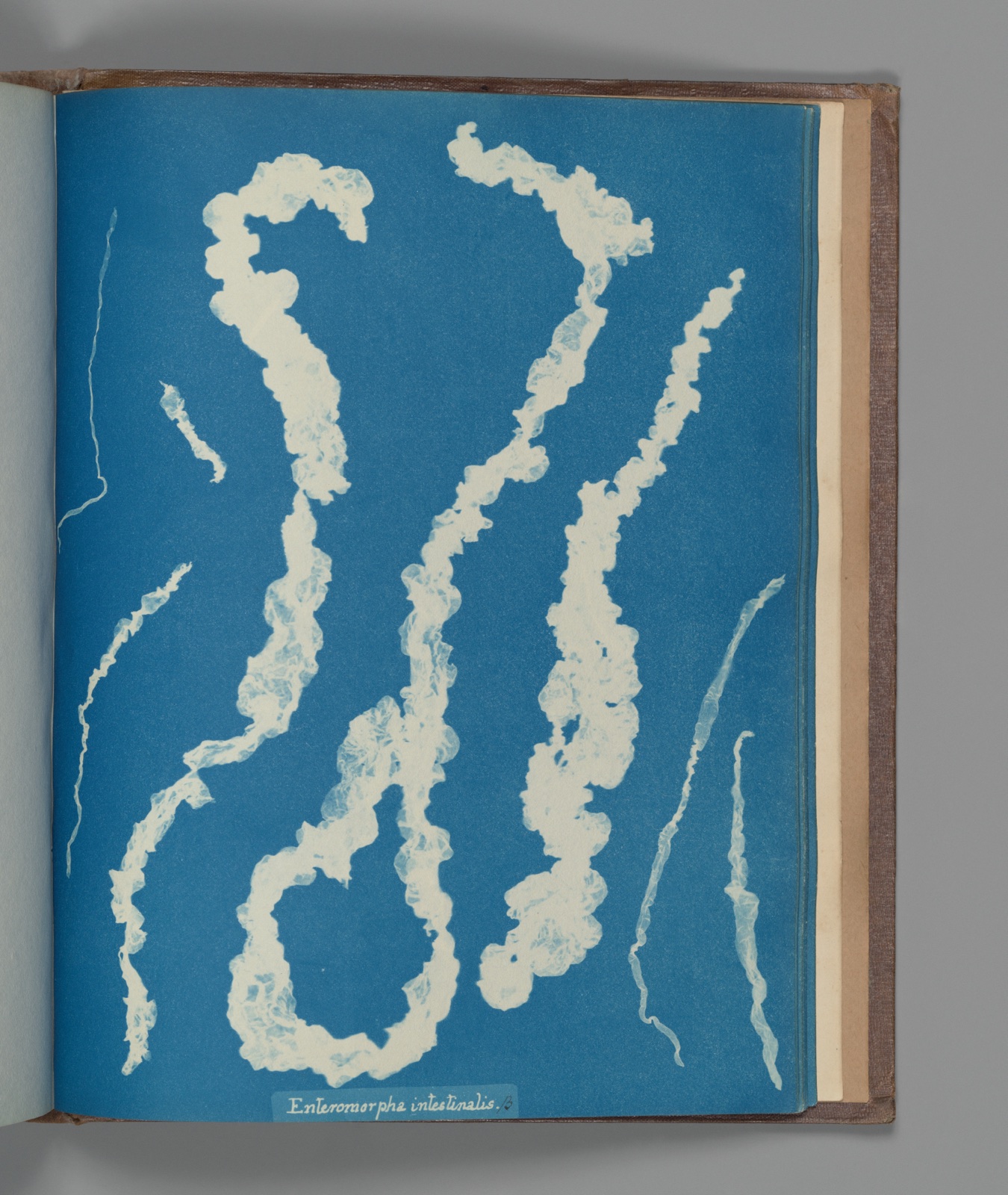
Look at the spaces between the branches
The cover image, Rhodomenia Polycarpa, provides a useful exercise. Follow one pale branch with your eye and notice how often your attention moves into the surrounding blue. The empty areas help separate forms that might otherwise become an unreadable tangle. What seems like background is doing an essential part of the descriptive work.
Now consider the specimen’s position within the page. There are decisions here: how to spread it, how close to bring it to an edge and how to leave room for a name. Recognising those choices does not make the image less scientific. It reminds us that useful description often requires deliberate composition. Clarity is made, rather than automatically delivered by a recording technique.
A book made photograph by photograph
Photographs of British Algae: Cyanotype Impressions began appearing in 1843 and developed over the following decade. Museum accounts identify it as a landmark in photographically illustrated publishing. The Rijksmuseum’s copy contains hundreds of handmade cyanotype plates, a reminder of the labour behind a project that can now be browsed with a few taps.
Think about the difference between copying an image mechanically and making another contact print. For each sheet, arrangement and exposure still have to happen. An album is not simply a container into which finished pictures disappear; it is the outcome of many individual acts of preparation. The repeated blue pages carry that accumulated work, even when their visual consistency makes the sequence seem effortless.
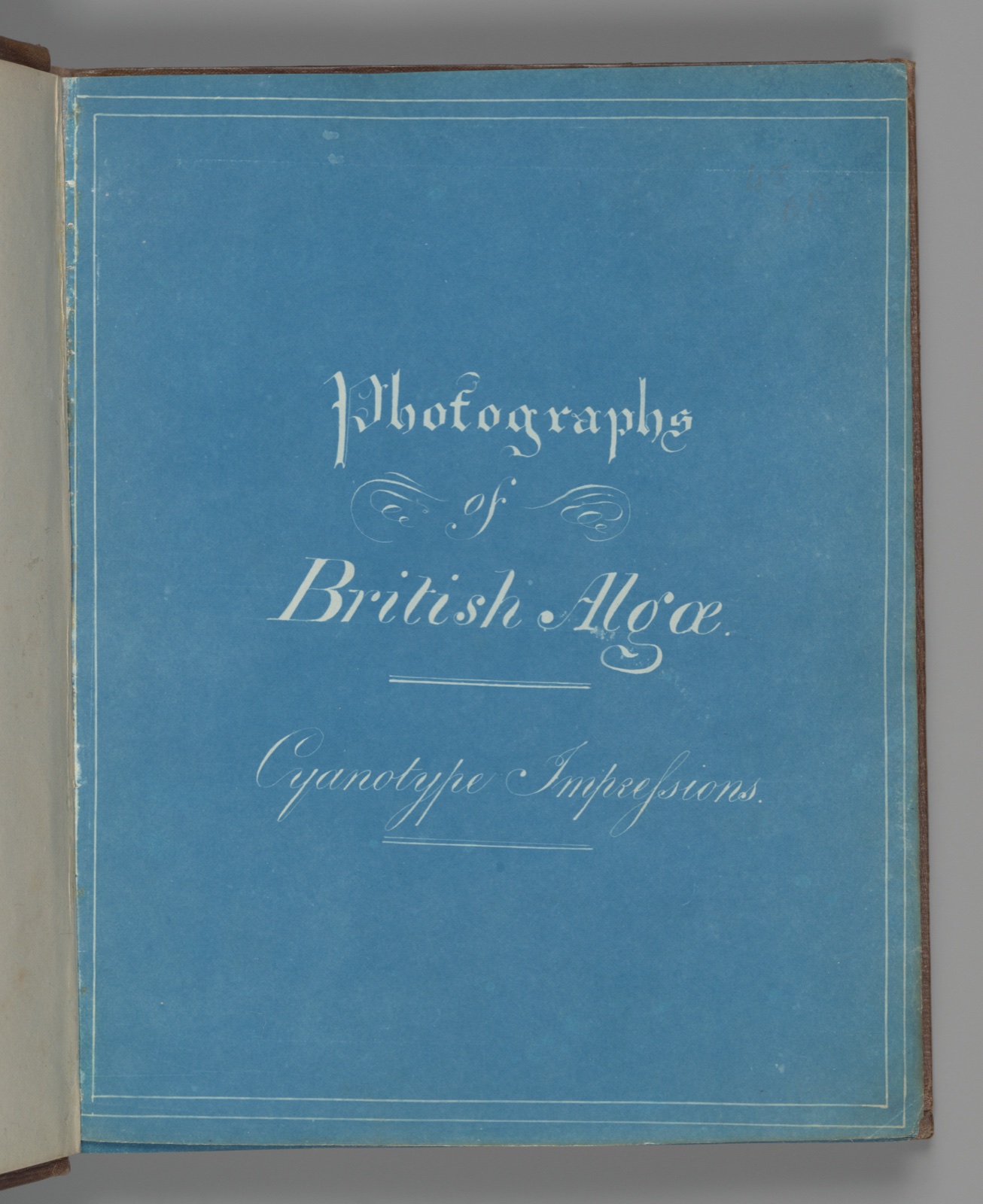
Read the lettering as part of the photograph
The title page reproduced above makes the photographic status of the book especially clear. Words, borders and flourishes belong to the same blue surface as the botanical impressions elsewhere in the album. Text is not merely an explanation attached to a picture: it contributes to the page’s visual rhythm.
When reading a photographic sequence, we often separate the image from its caption too quickly. Atkins’s pages encourage a slower approach. Notice how a name changes the way you attend to a form. Without it, you may see an abstract pattern; with it, the pattern becomes a specific subject that can be compared with others. Neither experience cancels the other.
Art and evidence need not be opposites
It is tempting to resolve Atkins’s work into one category: scientific record or beautiful image. A more rewarding reading allows both to remain active. The same arrangement can make a structure easier to recognise and give the page its elegance. Precision and visual pleasure are not necessarily competing goals.
For contemporary photographers, this is a useful challenge to the idea that a practical assignment leaves no room for authorship. The care taken with scale, isolation and sequence can shape meaning even when the purpose is description. Conversely, admiring the blue should not cause us to overlook the names, specimens and systems of knowledge that motivated the work.
An exercise for your next editing session
You do not need to copy Atkins’s process to learn from it. Choose five photographs of a related subject in your own archive. Look first at what each frame describes, then at the relationships between frames. Does an image add information, repeat a shape or interrupt the sequence? Could changing the order make a distinction easier to see?
Finally, write a short, precise caption for each picture. Avoid using the caption to claim something the photograph cannot establish. This exercise translates one of the most enduring qualities of Atkins’s albums into a modern workflow: an image becomes more useful when it knows its relationship to the page, the label and the next image.
Photographer profile
| Entry | Details |
|---|---|
| Photographer | Anna Atkins |
| Life dates | 1799–1871 |
| Practice | Botanical photography, illustration and collecting |
| Key work | Photographs of British Algae: Cyanotype Impressions, begun 1843 |
| Process | Cyanotype; camera-less botanical contact prints |
| Suggested reading | Corey Keller, Anna Atkins: Photographer, Naturalist, Innovator, Getty Publications, 2025 |
| Images in this article | Official museum reproductions designated Public Domain / Open Access |
| Information checked | 25 November 2026 |
Sources and image credits
Biographical and process context: Natural History Museum. Album and handmade-print context: Rijksmuseum. Further reading: Getty Publications. Cover and illustrations: official public-domain records for Rhodomenia Polycarpa, Enteromorpha intestinalis ß and the title page. Reading suggestions are our editorial interpretation of the reproduced works.