
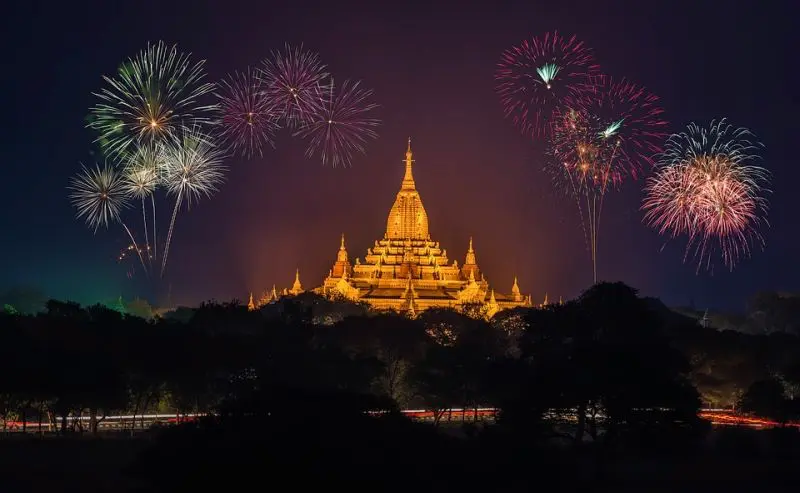
 Summer is the season of festivals, beach parties, and fireworks.
Regardless of our age, we have all at least once found ourselves looking up admiring a fireworks display.
Fascinated by the multicolored lights, surprised by the bursts, as photographers we have surely tried at some point to capture fireworks. However, often the result has not been the best.
Getting beautiful images is not impossible; the first thing to do is to forget automatic mode and follow these tips.
1. Position
You can take good photos of fireworks with just an image of the colorful explosions in the sky. But great fireworks photos need something more: a setting or a interesting foreground.
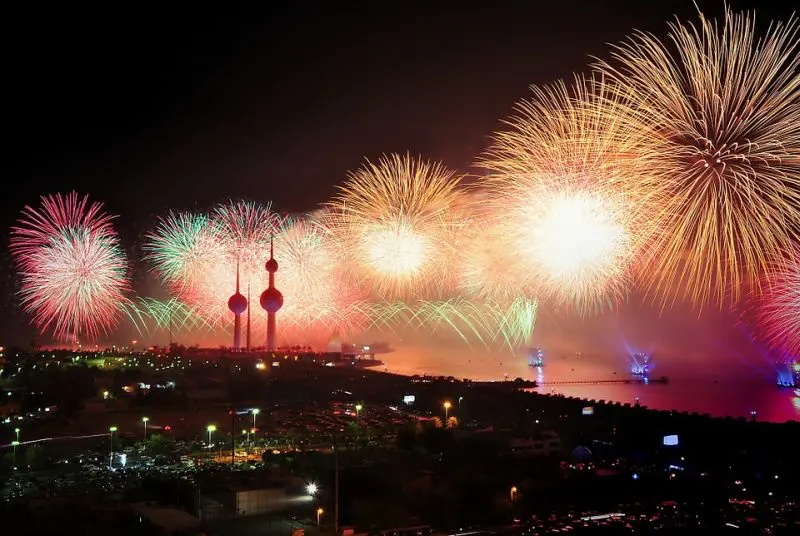
At every New Year's Eve celebration, on television and online newspapers, there are always images of New York with the Statue of Liberty surrounded by fireworks, Sydney's Harbour Bridge with light reflections on the water, or some Chinese or Emirati skyscraper erupting flames from everywhere.
A beautiful setting definitely helps to have an interesting image.
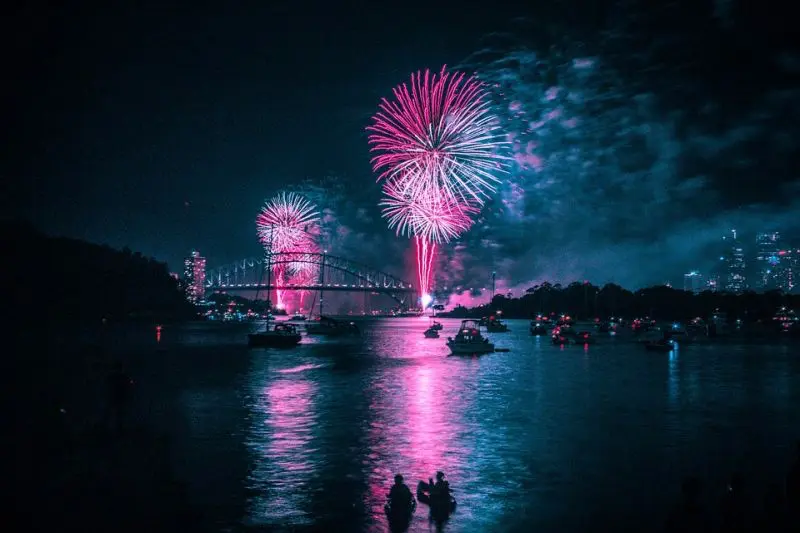
Even if we don't have such fascinating scenes available, we must find a good vantage point and avoid having it 'taken away' from us! At a fireworks show, you will definitely find people.
Plan to arrive early at your spot so you can "stake out your spot": a blanket on the ground to ensure you have an unobstructed view of the show, for example.
So, if you don't have other foreground elements, consider making the crowd your foreground; their heads stand out against the sky and the fireworks.
Another possibility could be to find a less obvious position, not exactly where the fireworks will be launched. Maybe there is a landmark, a line of trees, a high vantage point, or some other spot that will create an interesting foreground which, while including the fireworks, will provide context, location, and 'story' to your photos.
Scouting well before the night of the show is a good idea.
2. Equipment
What will you need to take good photos of fireworks? Let's analyze the basic equipment requirements:
- Camera: although you can take photos of fireworks with a cell phone camera, the results probably won't be as impressive. The best thing is therefore to have a DSLR or a camera mirrorless, with the option for manual control. Make sure you have a memory card of good size, as well as a spare battery or two, since you will usually take many shots during a fireworks show.
\t
- Tripod: fireworks photography requires a camera steady, since you shoot in low light conditions and take longer exposures. Consider a tripod practically mandatory for this type of work. Also, an L-bracket on the camera or at least a tripod that will easily allow you to switch from horizontal to vertical mode. You might often shoot in both orientations.
- Lens: the choice of lens largely depends on how close you will be to the fireworks launch site. If you are very close, you might need a wide-angle lens to keep the larger fireworks in the frame. However, if you are far from the show or want to compress the apparent distance between the foreground subject and the exploding sky, a telephoto lens might be the best solution. You don’t need a particularly fast lens since you will be working with medium-small apertures and longer shutter speeds. However, a sharp lens is always a good thing.
- Remote control: a remote shutter release is essential for two good reasons. If you use a tripod and then have to press the shutter button to take the photo, this introduces vibrations that can cause blurred images. Also, if you are focused on shooting carefully to avoid moving your camera, you will likely end up not enjoying the show.
\t
\t
\t
3. How to set up the camera for fireworks
Automatic or semi-automatic modes (aperture priority or shutter priority) are enemies of shooting fireworks. In this case, the correct choice is full Manual mode.
To take advantage of image correction possibilities without loss of detail, set the camera to RAW mode (possibly RAW+JPEG if you want to immediately post images on social media).
Using RAW mode also means you don’t have to spend too much time choosing the correct white balance: you can always correct it later in post-processing.
Working in low light conditions risks introducing a lot of noise into images. However, since fireworks are much brighter than the backgrounds, it is possible to keep the Low ISO (e.g. 100 ISO).
Many cameras have a noise reduction function: immediately after your exposure, the camera performs a second “black” exposure detecting thermal noise and subtracting it from the initial exposure.
This function helps you eliminate any thermal noise, but it introduces a significant time delay. This will waste precious time, so you might not be able to capture the fireworks images because the camera is already busy doing something else.
You are still shooting at low ISO, introducing little noise, so disable this function.
Regarding the aperture there are two things to consider:
- How much depth of field do you need?
- What is the "weak spot" of your lens?
\t
\t
First of all, since the fireworks will be at a good distance from the camera, you will focus on something farther away and will probably have a fairly good depth of field.
Working at wider focal lengths also helps. Plan to be in your position well before the show starts and have an idea of where you will need to focus and how much depth of field you need. Secondly, most lenses perform best between f/8 and f/16. Find out where your gear performs best and use that aperture if you can.
4. Choosing the shutter speed
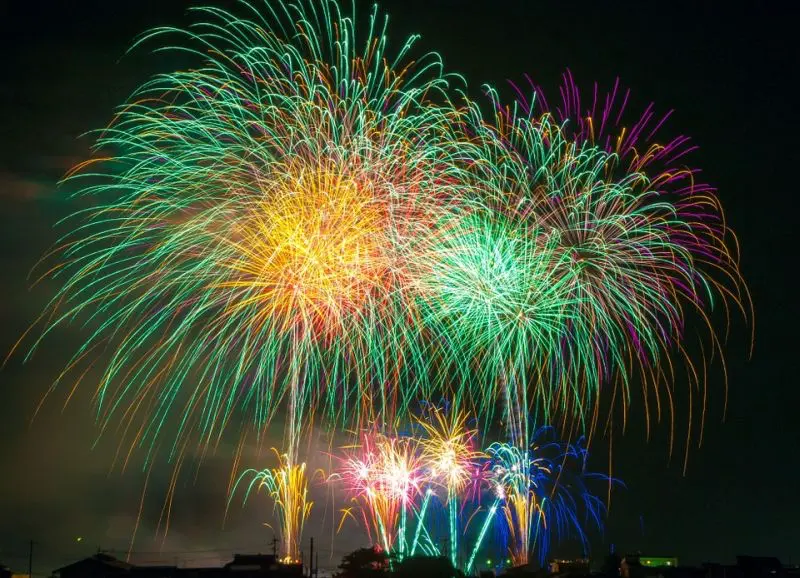
The choice of shutter speed will be important for taking good fireworks photos. Often multiple fireworks are launched in quick succession, close to each other. What you are trying to capture is the entire event which can sometimes last several seconds.
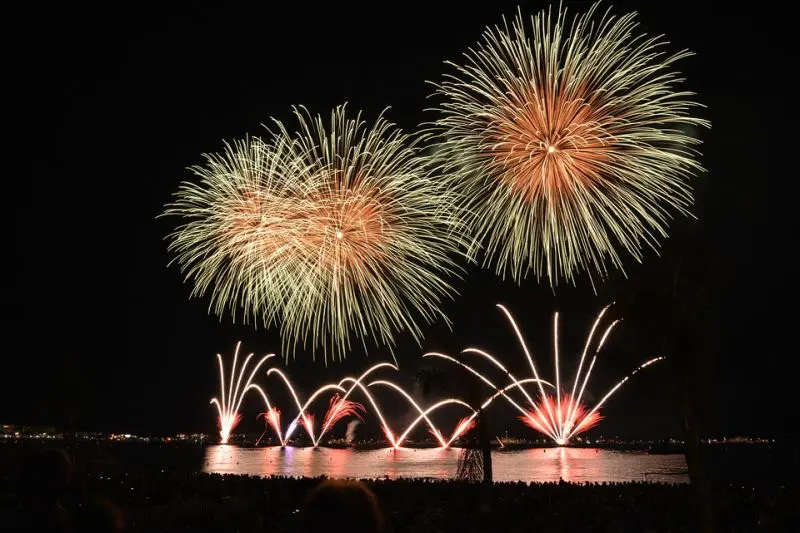
You might choose a fixed shutter speed of, say, four seconds, but would that be too short? Too long? Of course, it depends on the duration or sequence of the individual fireworks you want to capture, which will vary during the show.
So how do you choose? By using the Bulb mode you will be able to keep the shutter open and capture multiple fireworks, closing it whenever you want.
5. Use Bulb mode
The camera in Bulb mode allows a variable shutter speed. As long as we hold down the button, the shutter remains open. Release it and the shutter closes, ending the exposure. A variable shutter speed is the correct answer for fireworks photography.
Let's summarize the main points: camera on a tripod, shooting settings RAW, mode manual, noise reduction off, focus manual, lens vibration reduction (VR/IS) off, ISO 100, aperture from f/8 a f/16 (depending on the lens you are using), mode Bulb.
Also remember: No flash. Rarely (unless perhaps to illuminate a foreground object), will it ever be necessary to use flash when photographing fireworks.
Also, consider if others are nearby watching the show. Using flash is guaranteed to make you unpopular with other fireworks spectators. Unless you are alone and have a good reason to use flash, don't use it.
Remember, once the show starts, you will be busy. Be ready, think ahead, and when the show begins, start clicking.
6. Shooting technique
You have set the camera on a tripod, figured out where to point it, make sure to pre-focus on a distant point and lock the focus by setting it to Manual focus (MF). If you leave the camera on autofocus, it is almost guaranteed to give you images that are a person's torso rather than a burst of an explosion.
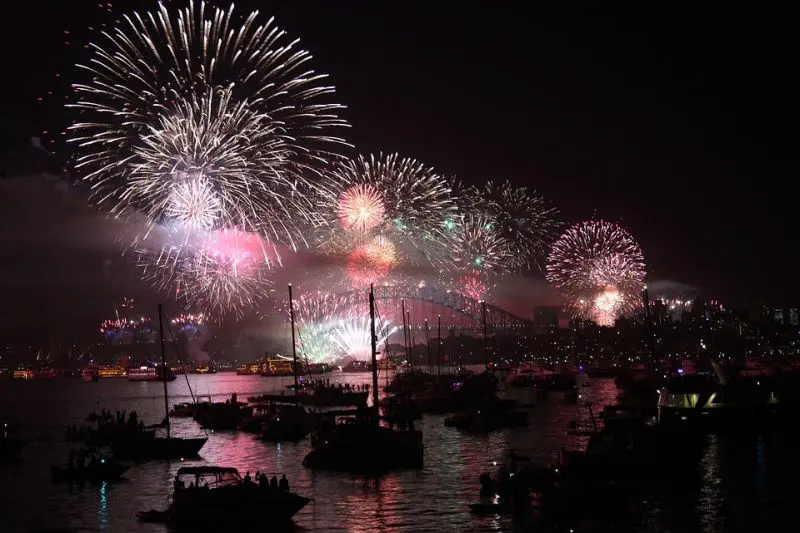
Against the dark sky and moving fireworks, autofocus will definitely fail.
Often the best images can be made right when the show starts, after the smoke from previous fireworks becomes denser and the fireworks more obscured.
So, when you hear the boom of the first firework rising, click and hold the button on the remote. You will be in Bulb mode, so keep it open while the firework rises, explodes, and radiates. Then release the shutter button.
Now quickly check your shot. Is it in focus and properly framed? Is it properly exposed? If it's too dark, increase the ISO by one stop or maybe open the aperture by one stop. Too bright? Do the opposite.
Try not to spend too much time doing this since, obviously, the show will continue without you. Some fireworks will be much brighter than others, especially a multiple burst or the finale. So quickly check your histogram and make sure you haven't clipped the right side of the histogram (the brightest points).
Make the necessary adjustments and then keep clicking. Change the zoom if needed, but frame a bit wide if anything. You can always crop tighter later. Otherwise, if that really big and spectacular explosion is so large it goes out of frame, you'll miss it. Try both vertical and horizontal orientation shots.
Conclusions
Unfortunately, there are often not many great opportunities to practice. So having a good foundation is essential for successful fireworks photography.



