
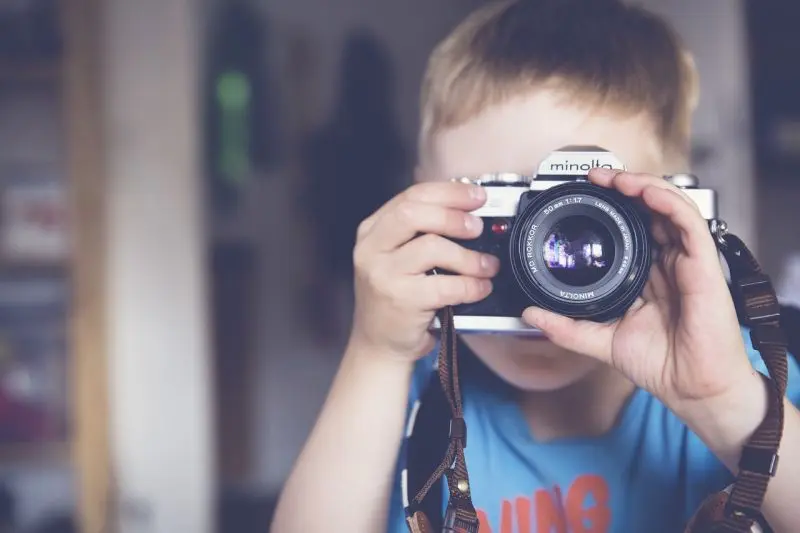
 Every photographer's dream is that their own children embrace our hobby too.
Starting as a game, perhaps with those instant-print cameras to immediately show the result obtained (watch out for the costs, though!), it might be possible to quickly find an enthusiast with whom to share time and experiences.
Teaching photographic technique, without “killing” the playfulness of the experience and limiting the chance to make mistakes from which to learn, is not easy. Some advice can still be very useful.
Don’t shoot repeatedly
With the relative affordability of taking digital images, the first thing children (and not only them) do is shoot repeatedly without giving any thought to what they are doing. A photo will almost certainly turn out well, but more by chance than as an actual acquisition of photographic skill.
Obviously, especially if very young and if everything is seen mostly as a game, this will be hard to enforce, but, with the right approach, the sooner you start teaching to “think” about the photo, the better.
The child’s own camera
If you let your child use your camera, it won’t turn out well. Keep in mind they are children and may not treat your expensive camera body and lens with proper care. Also, such devices are made for adult hands, so they may not be easy for a child to hold.
Put yourself in their shoes: would you enjoy yourself if you risked being scolded for how you handle your parents’ equipment?
A simple camera that is resistant to shocks, drops, and infiltration of water and dust, so it can be used safely at the beach or in the pool, is definitely the right choice. See here the best cameras for children.
There is no single position
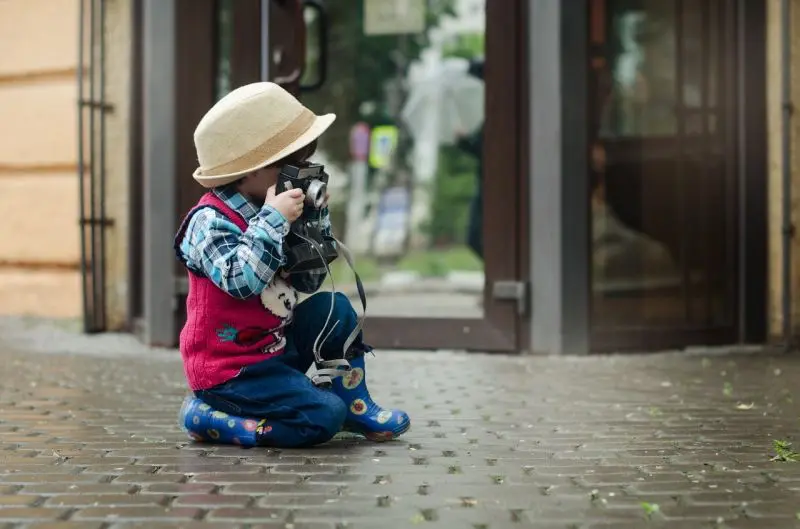
If everyone shoots the same way, only the same images can be obtained.
Changing the shooting position changes how the image is perceived. Teaching this is definitely one of the most important points.
So teach the child to shoot from different perspectives (high, low), getting closer and moving away from the subject to fill the image differently, moving around the subject to capture different views, changing the settings of the camera (if the camera allows it).
This is also a game: seeing how the same subject transforms as the settings and shooting position change.
Controlling the backgrounds
One of the most common mistakes any photographer makes is taking a nice photo of the subject but getting the background wrong (with distracting elements, cluttered, drawing the eye away from the proper view of the subject).
Teach children to quickly scan the background (and the foreground) of an image and adjust the framing if there are too many distractions.
Keep the camera straight
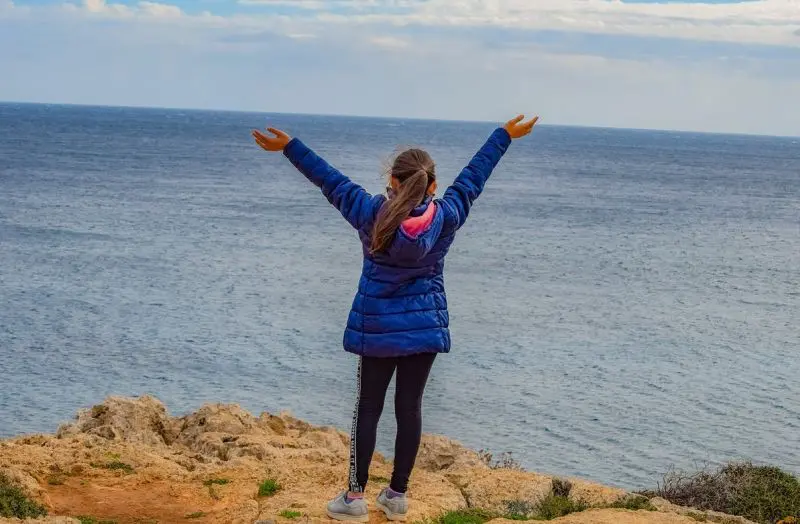
An horizon tiltedand it always introduces something odd into an image.
Learn right away that horizons must be straight avoids future messes and disappointments. It’s true that a digital image can always be retouched and straightened, but starting off on the right foot is better.
Today, even the most affordable cameras can have some help (guidelines, electronic level) to check if the image is tilted or not.
How to hold a camera
It’s easy to assume everyone knows how to hold a digital camera. However, while many do so intuitively, some don’t, especially children unfamiliar with the equipment. So teach how to hold the camera firmly to avoid unwanted movements.
Images that suffer from some camera movement due to poor technique are not rare (even among adults).
Get closer
Unfortunately, budget cameras don’t have powerful zooms. While this is undeniably a problem, on the other hand it could be an opportunity.
If we look at the shots around, many the subject is too far away. Getting close to the subject is very important.
So understanding that getting closer can help you capture details and perspectives otherwise impossible with the use of a zoom is very important, especially with a future as a photographer in mind.
Shoot, shoot, shoot
This might seem like advice contrary to what we wrote earlier, where we said not to shoot repeatedly.
Obviously, the two pieces of advice complement each other: don’t shoot bursts mindlessly just to have some photo (100 photos of the exact same subject), but taking many photos is the only way to learn photography.
Only by photographing is it possible to improve your technique, know your equipment inside out (whatever it may be), and learn to explore different photographic techniques. On the other hand, this is an undeniable truth regardless of the photographer’s age!
Encourage therefore the child not to hesitate to explore something new.
Achieving the right balance between photographing people, "things," and places
Subjects are very varied. If not encouraged to explore something new, there is a risk that children focus only on what they like most at the moment.
Looking back at the photos after some time, you might notice a single recurring theme (buildings, flowers, animals, …). The memory of a trip can, for example, be very limited and focused on a single subject, and this is definitely a pity.
So get children used to trying different subjects, not just those within their own “comfort zone”.
Find a point of interest
Interesting photographs have something interesting within themIt is an obvious statement, but many photos seen at friends' gatherings after a trip actually have nothing interesting in them.
An image, to be interesting, needs a visual point of interest (a focal point).
Teach children to identify this point of interest before actually taking the photograph. Once the point of interest is identified, they can then think about how to highlight it (changing the shooting position, using zoom, etc.).
Rule of thirds

Like all photographers who follow the photography course on Photoblog, the rule of thirds and the golden section are two important rules that should be known to create beautiful photos.
Although they are not so easy for a child to master (especially the second one), the message to convey is that by placing the subject off-center in the frame, often the result is better.
Only by knowing these rules can they then be consciously broken to achieve even better images!
Review with them the images your children have taken

One thing you can do to help your children drastically improve their photography is to sit at the computer with them after they have been out with their camera taking shots.
While scrolling through the images, highlight what they did well and comment on things they could do better next time to improve their results.
Pay particular attention to the shots they do well, as this will give them positive reinforcement and inspiration to continue with their hobby. Remember that this final analysis it's not a test!
Focus Lock
An important technique that children will do well to learn is how to use the focus lock.
While most cameras work well with autofocus on subjects, there are times when the results are shots that are out of focus because the camera doesn't know which is the main subject (especially if they place subjects off-center using the rule of thirds).
Teach your child how to half-press the shutter button to focus and then compose the shot while still holding it down, and they will have a skill they will use forever!
Different modes for different situations
All modern cameras have various "shooting modes": portrait, sports, macro, etc.
Teach your child what these modes mean and when to switch to them, and you'll be one step closer to them understanding how their camera works and how to learn manual exposure modes (see the next point).
Knowing that different situations mean you need to use different settings is an important lesson for children to learn, as it helps them become more aware not only of their subject but also of how things like light, focal length, and subject movement can have an impact.
Exposure Settings
Once your child has gained a good understanding of the techniques above, it might be time to teach them some basics of exposure (this might be a task for slightly older children).
Learning about the three elements of ISO, Aperture, and Shutter Speed is a useful starting point for your lessons and gives them an introduction to how changing these settings can affect a photo.
And you, what do you teach your children?



