
When does it make sense to increase the ISO value? In what context and type of photography should you consider using a high ISO? How many ISO can modern cameras handle?
In this article, we will try to understand how far we can push the ISO and explain some tricks to best manage every situation. Increasing ISO in photography is one of the most common "photographic fears," especially among beginner photographers who prefer to stay below 400 ISO to avoid ruining photos with unpleasant and unwanted digital "noise."
This fear could be justified many years ago when taking a digital camera to ISO 1600 was almost impossible for most cameras on the market. However, things have changed a lot now, and the vast majority of today's cameras easily support ISO up to 3200, with much higher peaks in professional cameras. But let's start from the beginning. What is ISO sensitivity?
ISO sensitivity indicates the sensor's ability to be impressed by light. Depending on the digital camera, you may find different ISO value scales, but in most cases, the scale you will encounter will be similar to this:

Looking at the value scale, the lower the number, the less sensitive the sensor is to light. This implies that if you want to use very low ISO values, there must be perfect lighting conditions. Conversely, a higher number indicates greater sensitivity to light, allowing the sensor to work better in low-light conditions.
Increasing ISO sensitivity also increases what in photography is called “noise”, one of the main enemies of photographers. Noise is nothing more than a signal of disturbance made up of random pixels that vary the brightness or color of the image.
Does it make sense, then, to increase the ISO value? In what contexts can we increase this value?
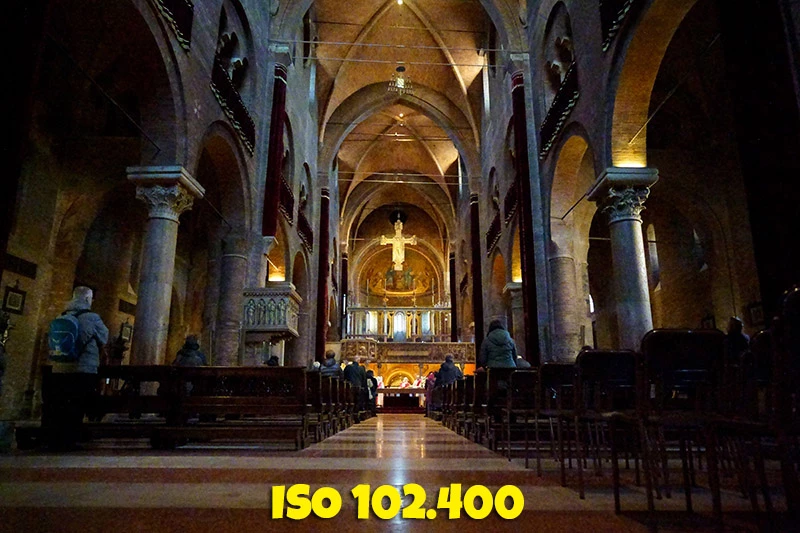
Night photography or indoor environments with low light
If you have ever shot at night or even simply indoors, perhaps in the evening, with low light, you have surely encountered the most common problem for this type of photography: having dark shots lacking details, often also blurry.
In these cases, there are 3 steps to take:
- After setting manual shooting mode, open the aperture as wide as possible so that the most light can enter... but 99 times out of 100, it's not enough
- Increase the shutter speed to let in more light, but unless your subject is completely still and motionless, the final photo will definitely be blurry.
- Third and last option: increase the ISO. Will this cause noise and ruin the photo? It depends on how high the ISO is set and how well your camera can handle noise, but we can guarantee that it is ALWAYS better to have a slightly "grainy" image than a blurry, dark, and detail-lacking one!!!
Photography of moving subjects
Have you ever tried to photograph a running child? A car speeding on a track? A tennis player serving or a hawk in flight? If the answer is yes, you will have noticed that photos of fast-moving subjects are almost always blurry and out of focus. This is because the shutter speed is not fast enough to freeze the movement of the subject in the frame.
The solution seems obvious: reduce the shutter time to the minimum, but this means reducing the amount of light entering the camera, resulting in a dark photo lacking detail.
Here too, increasing the ISO sensitivity comes in handy. It might cause some background noise, but by doing so you can be sure to capture perfect images with a very fast exposure time that will flawlessly freeze the movement of your subject in the frame.
Photography with telephoto lenses
When using "pushed" telephoto lenses, the risk of blur is just around the corner, just like with photographing a moving subject. Even in this case, increasing the ISO sensitivity, even slightly, can help you get sharp photos without any blur... even with a 400-600mm telephoto lens.
"I've always been told that low ISO means better photos, is that true?"
The answer is YES and NO.
- Yes, if you are photographing in a studio with perfectly controlled lights and flashes and no lighting issues.
- Yes, if you have the possibility to use a tripod and have no issues using long exposures or photographing moving subjects.
- Yes, if you are landscape photographers shooting in full natural light.
- Yes, whenever you manage to perfectly expose the final photo without compromising shutter speed or aperture value.
In all these cases, a photo taken at 100 ISO will definitely be better than the same image taken at 3200 ISO, always!!!
In all other situations, it is always recommended to increase the ISO sensitivity to properly expose the final photo. It's always better to have a "grainy" photo than a blurry one... moreover, the latest generation cameras have not only significantly reduced the problem of digital "noise," but have also transformed it into a pleasant artistic soft grain effect, so... DON'T BE AFRAID TO INCREASE THE ISO SENSITIVITY!!!
How much to increase it?
Well, this depends on multiple factors, primarily the quality of the camera you are using. Our advice is to test your camera. Go to a place with low light conditions (like inside a church) and repeat the same photo while gradually increasing the ISO sensitivity. Once you get home, you'll immediately realize how far you can push your ISO.



