
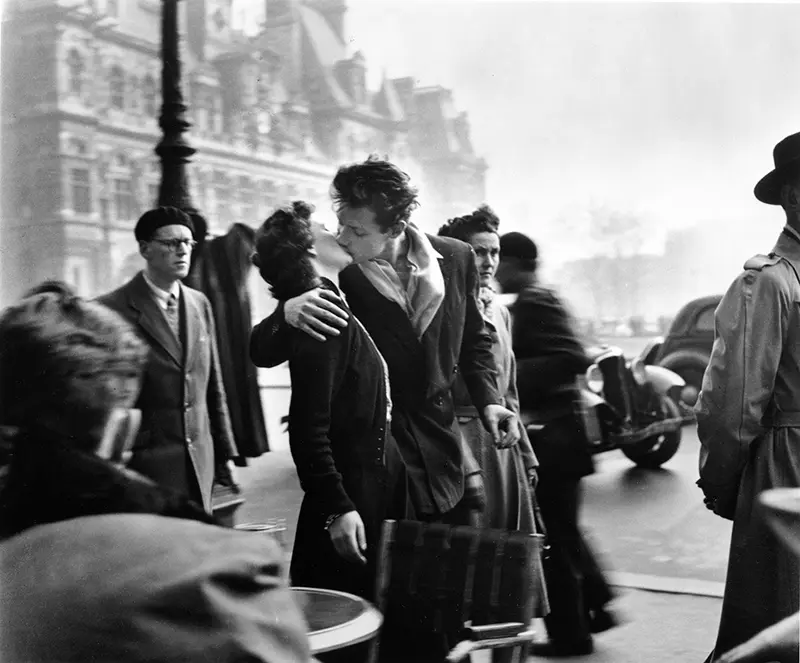
The most beautiful kiss in the history of photography? Impossible to determine. But it is certain that a place on the podium belongs to the image of the young couple, indifferent to the crowd of passersby and the traffic of the place de l'Hôtel de Ville in Paris.
The author is Robert Doisneau, the great master of photography to whom Palazzo Roverella will pay tribute in autumn 2021 through an original exhibition, capable of revealing to the public works whose vocation is precisely to capture moments of happiness like this.
Together with Henri Cartier-Bresson, Doisneau is considered one of the founding fathers of French humanist photography and street photojournalism. With his lens, he captures the daily life of the men and women who populate Paris and its suburbs, with all the emotions of the gestures and situations in which they are engaged.
This exhibition at Palazzo Roverella embraces his work without chronological distinctions or any genre or theme criteria, juxtaposing factories, bistro counters, concierge desks, ceremonies, jazz clubs, schools, or street scenes in general. Whether the photographs were commissioned or the result of his free roaming around Paris, we see a style emerge imbued with a particular mindset, which also shines through in his writings and photo captions; a style that mixes charm and fantasy, but also a freedom of expression not far from surrealism.
If style is the man (as Buffon says), in the same way photography identifies with some of its subjects to express a kind of restlessness or melancholy. A narrative – that proposed by the curator of this exhibition, Gabriel Bauret – conducted through 130 black and white silver gelatin prints, from the collection of the Robert Doisneau Atelier in Montrouge. It is in this atelier that the photographer printed and archived his images for over fifty years, and it is there that he passed away in 1994, leaving a legacy of nearly 450,000 negatives.
Doisneau's storytelling is light, ironic, and winks sympathetically at people. It even becomes tenderly involved when photographing lovers and children. “What I was trying to show was,” the artist recalls, “a world where I would feel good, where people would be kind, where I would find the tenderness I hoped to receive. My photos were like proof that this world can exist.” “I like,” he continues, “people for their weaknesses and flaws. I get along well with ordinary people. We talk. We start talking about the weather and little by little we get to the important things.
When I photograph them, it’s not as if I were there examining them with a magnifying glass, like a cold and scientific observer. It’s a very brotherly thing, and it’s wonderful to shed light on those people who are never in the spotlight.” “The photographer must be like blotting paper, letting the poetic moment penetrate him. His technique should be like an animal function, acting automatically.” Doisneau was born in 1912 in the Parisian suburb of Gentilly.
His training as a photographer began with an apprenticeship in the studio of a commercial photographer. But his focus soon shifted to the working-class neighborhoods of Paris and the banlieue, images that began to appear in magazines through the Rapho agency, of which he was one of the most important members. Then the war pushed him to make himself available to the resistance to give a new identity to those wanted.
After the Liberation, here are some reports for “Vogue” and in ’49 the book made in collaboration with his comrade, the famous writer Blaise Cendrars, La Banlieue de Paris, the first synthesis of the many pictorial stories he would dedicate to this world. Doisneau describes its daily life, composing a visual narrative mixing deep humanity and a note of humor, always present in his work.
Robert Doisneau - Palazzo Rovella - Rovigo - From September 23, 2021 to January 30, 2022
More information: www.studioesseci.net



