
It is said that a photograph is correctly exposed when it faithfully reproduces the same amount of light that our eye sees.
When the photograph is too bright, it is said to be overexposed, conversely, when it is too dark, it is said to be underexposed. But what does exposure have to do with today's lesson?
There are 3 fundamental factors that influence the correct exposure of a photograph and they are:
ISO sensitivity (we will dedicate an entire separate lesson to this)
Aperture
Shutter
Learn these factors well because they will be useful in all the photographs you take. In this fifth lesson, we will focus only on how the aperture and the shutter. Look at the image below and follow the path of the light.
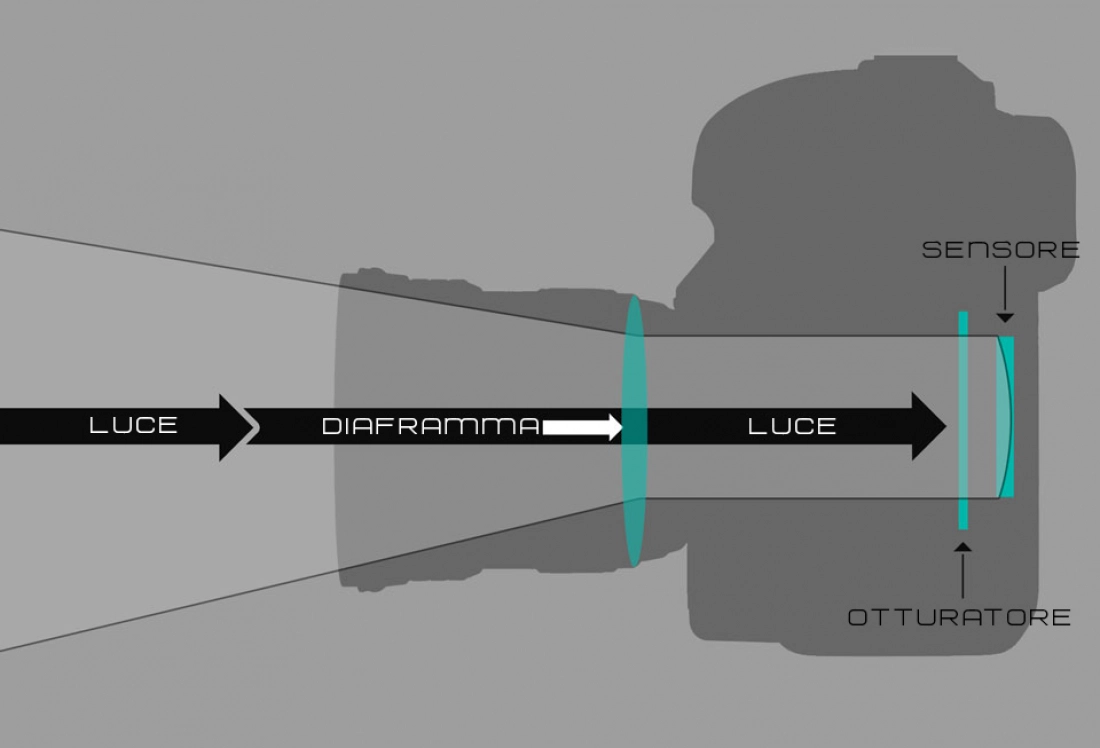
Before reaching the sensor and recording the image, the light passes through the lens elements, reaches the aperture, continues its path and finally passes through the shutter. Now you understand why aperture and shutter, being devices that allow more or less light to pass, are fundamental for correct exposure and the success of a photograph. Let's look at them one by one and you will understand how closely they are linked.
APERTURE
The aperture works similarly to the iris of our eye and is the mechanism used to regulate the amount of light passing through the lens.
The aperture is always located inside the lens and consists of a set of movable blades capable of creating polygonal openings of different sizes: the blades are hinged at one end while the other can move, controlled by a ring. This system is called an iris diaphragm. iris. The greater the number of blades, the better the quality of the aperture will be.
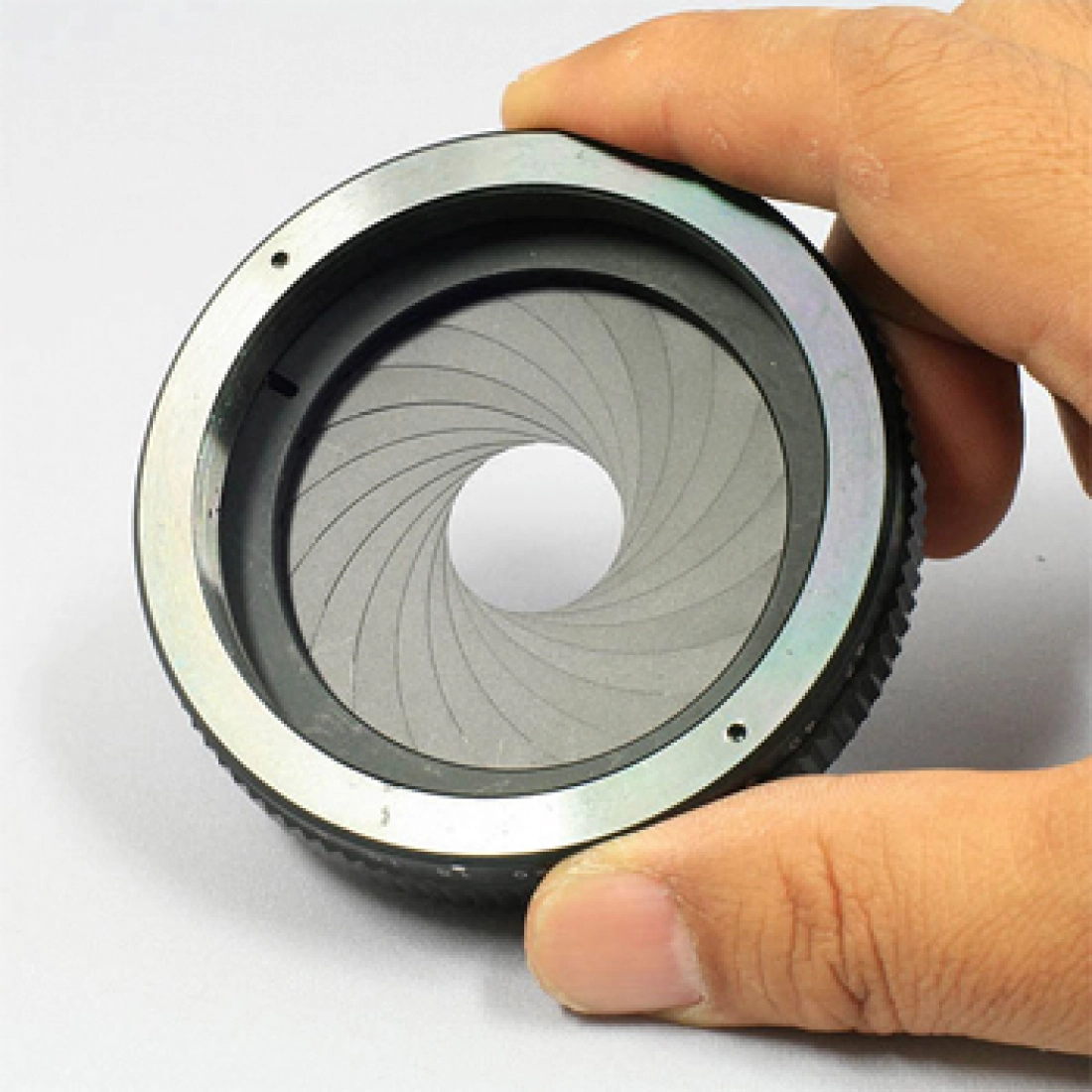
The aperture opening is measured with a value called "F" or "F-STOP".
The sequence of stops or values of the “f” numbers was standardized in 1905 and today all manufacturers use the following scale of intervals:
f/1 - f/1.4 - f/2 - f/2.8 - f/4 - f/5.6 - f/8 - f/11 - f/16 - f/22 - f/32 - f/45 - f/64 - f/90 - f/128 (etc).
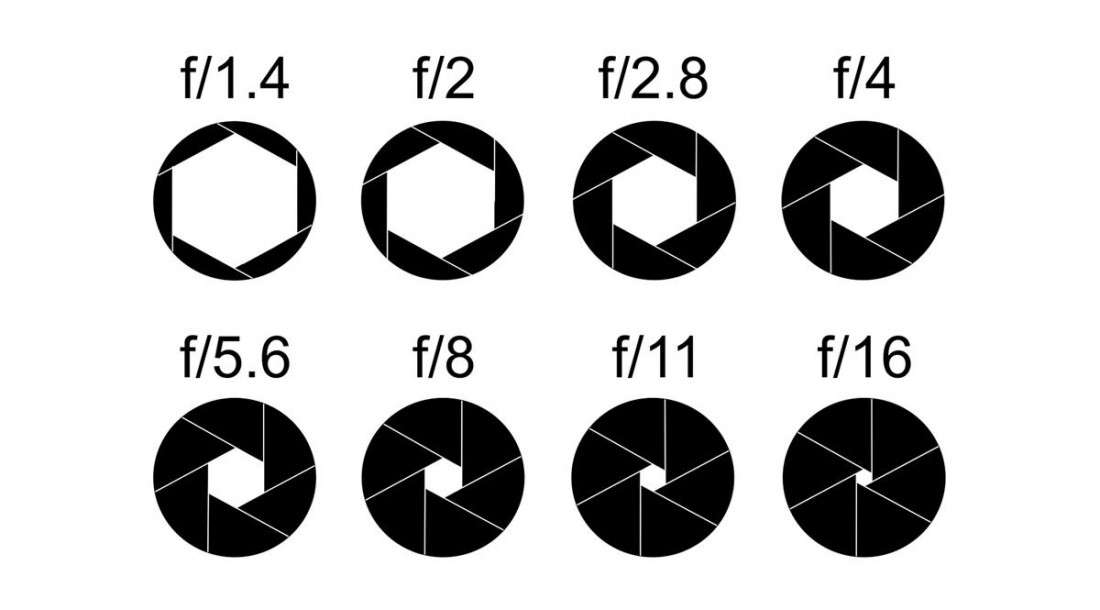
The lower the “F” value, the larger the aperture and consequently the amount of light entering the camera. (image below). A common example is to compare the aperture to a faucet: the more you open it, the more water flows through.
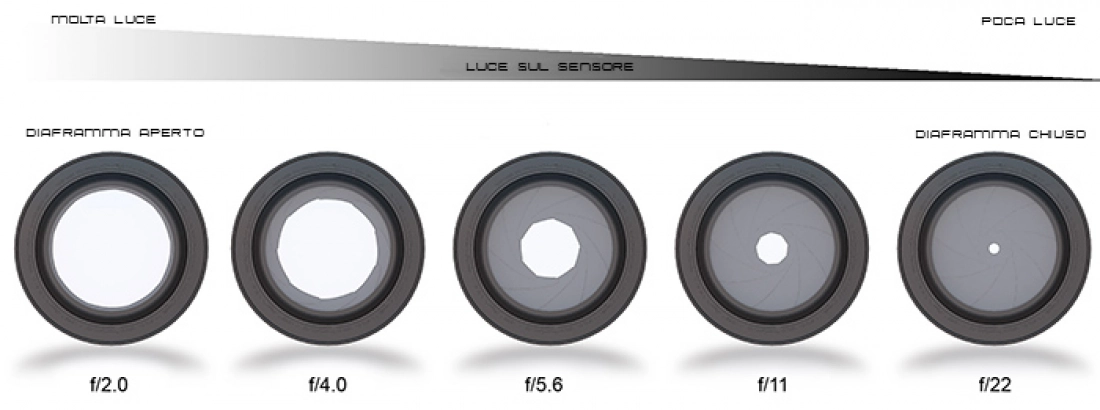
We will look at this more calmly in a lesson later on, but know that photographing the same subject with a very closed aperture (f22) and with an open aperture f2 will give you two completely different photographs... but there will be time for that.
SHUTTER
The shutter It is an electronic or mechanical device that controls how long the sensor remains exposed to light. Earlier we said that the aperture can be compared to the iris of our eye; in this case, the shutter is the eyelid!

The most common shutters today consist of a vertically sliding curtain that determines the exposure time. This exposure time is preset by the photographer and is measured in seconds or fractions of a second.
The scale usually used and that you will find on your camera is this:
30” – 15” – 8” – 4” – 2” – 1” – 1/2 – 1/4 – 1/8 – 1/15 – 1/30 – 1/60 – 1/125 – 1/250 – 1/500 – 1/1000 – 1/2000 – 1/4000
...but know it can vary depending on the camera model.
When the time is less than 1/125 of a second, it is called a slow shutter speed, while if we go beyond that (1/500, 1/1000 sec) we talk about fast shutter speeds. This is because 1/125 second has been considered the limit for handheld shooting; below this time, you need a very steady hand or a tripod.
RECIPROCITY RELATIONSHIP
The relationship between the aperture and the shutter is called the “reciprocity relationship”. The aperture opening is inversely proportional to the shutter speed (exposure time).
If I halve the shutter speed, I must double the aperture opening; conversely, if I double the time, I must halve the aperture!
Let's take an example: our photograph is correctly exposed (right amount of light) and was taken with an aperture of F2 at 1/125 of a second. If we wanted to get the same exposure by changing, for example, the aperture to F4 (less light enters), we would have to double the exposure time, which would go from 1/125 second to 1/60 (slower). (Look at the image below to understand better)
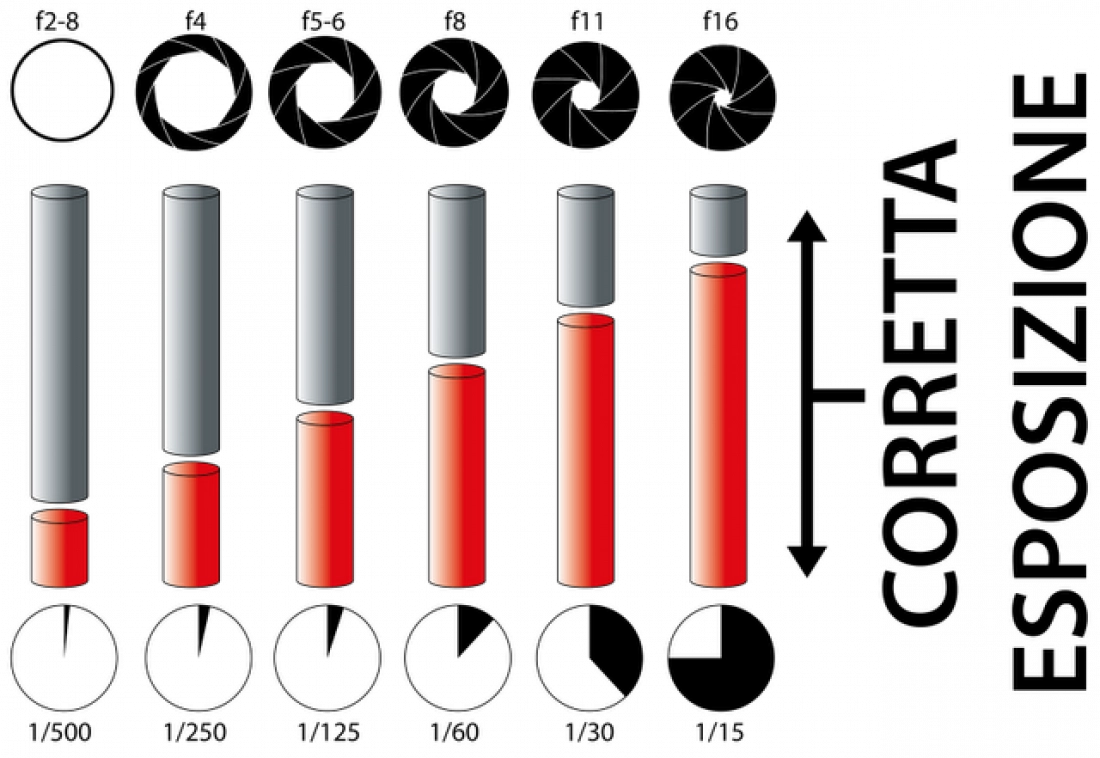
An example I often use and that you have probably already heard is that of the bathtub. Let's compare our FULL bathtub to our correctly exposed photograph.
We have 2 different ways to fill the tank:
- We open the tap (aperture) fully for a very short time (shutter). The bathtub fills quickly.
- We open the tap very slightly for a very, very long time. The bathtub takes a long time to fill.
It's true, in the end we would have the tank full in both cases but know that these are 2 completely different paths. In the next lessons you will notice that fast shutter speeds freeze action (sports photos for example) while long shutter speeds are mainly used when we have very little light. You will also notice that an open aperture creates a blurred background effect while with a closed aperture the entire image will be in focus.
But I don't want to give anything away; we will explore this further later. Just know that the functioning of aperture and shutter are the foundation of photography; their mechanism must be well understood, and you will see it will be useful in all your future shots.
If you missed the previous lessons you can consult this page where there is a summary of all the lessons of the course.



