
In this 6th lesson of the free online photography course, we finish examining this path of light by adding some secondary but equally important elements: the mirror, the pentaprism, the viewfinder, and the LCD display.
Let's start by saying that the mirror, the pentaprism, and the viewfinder are present only in DSLRs, while in compact or bridge cameras there is only an LCD display.
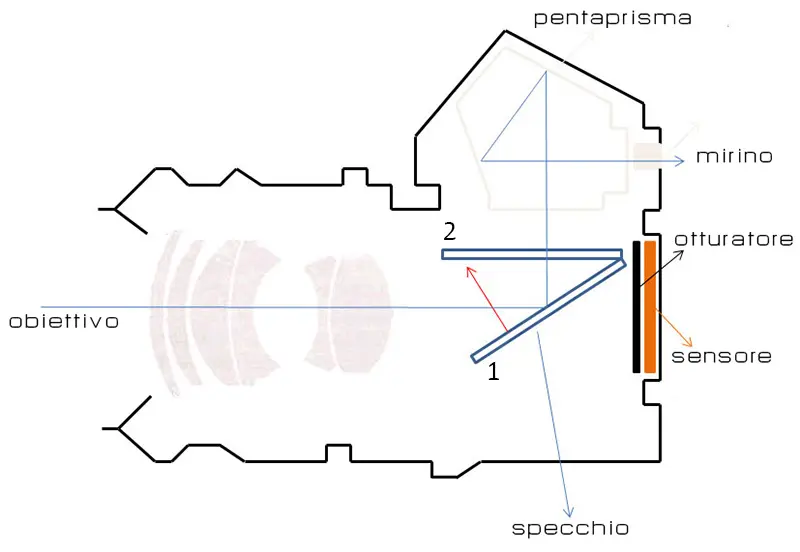
If we look at the image above, we can see the path the light takes before reaching our eye placed at the DSLR viewfinder. In the “non-shooting” phase, that is when we are still composing the image, the light enters the lens and, after passing through the aperture, hits the lowered mirror (number 1 in the image).
The light then continues its path to the pentaprism and after a couple of reflections reaches our eye. At the moment of the shot, however, the mirror is raised (number 2 in the image) and the light directly hits the sensor after passing through the shutter. During this fraction-of-a-second phase, if you have your eye on the viewfinder, you will notice the image disappears precisely because the mirror, when raised, blocks the light flow reaching the viewfinder.
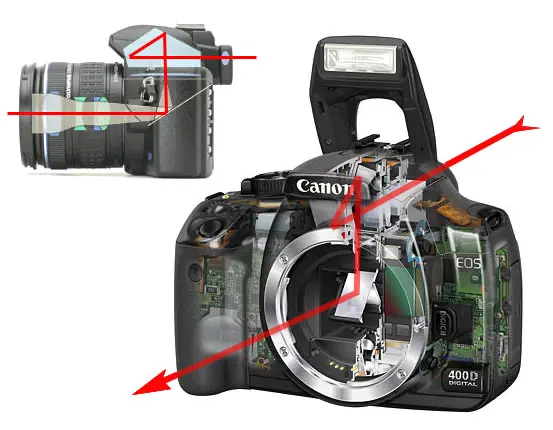
Recently, DSLRs have also been equipped with TTL (Through The Lens) technology for the viewfinder and have “approached” compacts. This technology allows you to see directly on the LCD display the image you are about to shoot (live view). In this case, the mirror remains raised, the shutter open, and the light hits the sensor directly. Through an electronic device, the image is then displayed on the screen.
There are PROs and CONs to using live view; it is certainly very convenient in some cases where we cannot always bring our eye to the viewfinder. However, using live view increases the sensor temperature and the image risks more “noise,” becoming grainy. Personally, I do not recommend shooting with live view; I almost never use it except in particular cases.
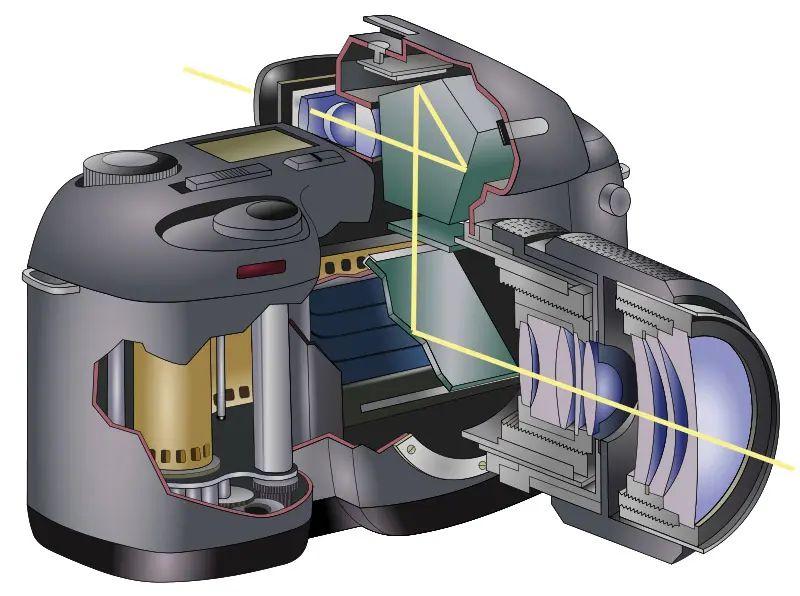
PENTAPRISM
A variant of the pentaprism is the so-called roof pentaprism, in it the image is horizontally inverted because a reflective face has been divided into two mutually perpendicular surfaces. These do not need to be made reflective because total internal reflection already occurs.
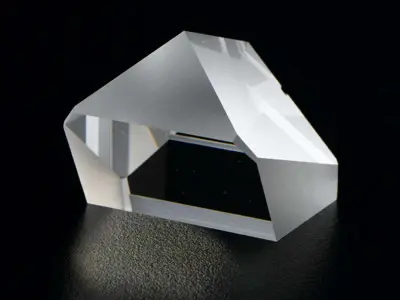 | |
The roof pentaprism is used in DSLR viewfinders because it allows seeing the image reflected by the mirror of such cameras without it appearing upside down or reversed left-right (the horizontal inversion introduced by the roof pentaprism compensates for that already present in the image reflected by the movable mirror).
A characteristic of the pentaprism is that the angle of the outgoing light rays is always 90° relative to the angle of the incoming rays; therefore, this optical component is insensitive to mounting tilt variations.
LCD DISPLAY
The LCD display is present on ALL digital cameras while it was completely absent on analog DSLRs. On this screen, the image we are about to capture is projected (directly with compacts and bridge cameras, in live view with DSLRs). After shooting, through the display, we can quickly review all the images just taken. This, in the digital era, is a great advantage because it allows us to notice any errors and retake the photo.
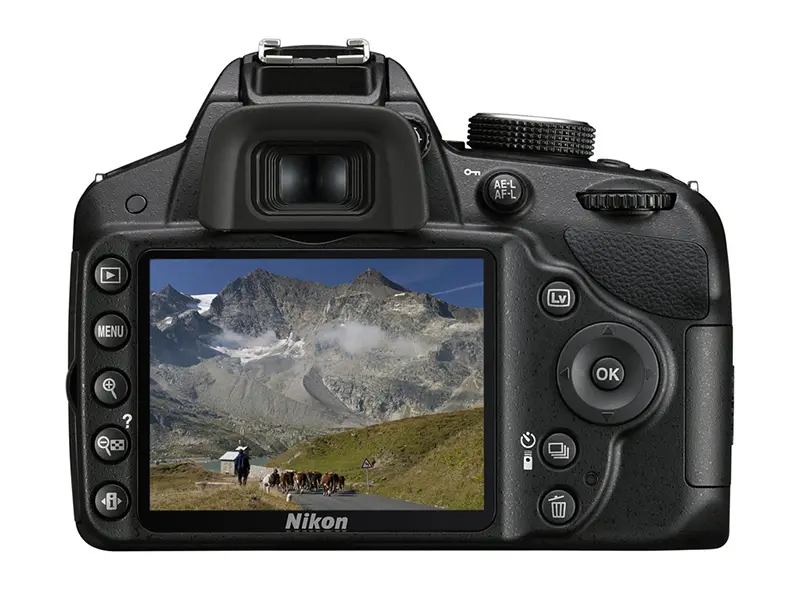
On the LCD display, it is also possible to quickly check the most important shooting parameters, including shutter speed, depth of field, and ISO sensitivity, and to view all the menus available on our camera.
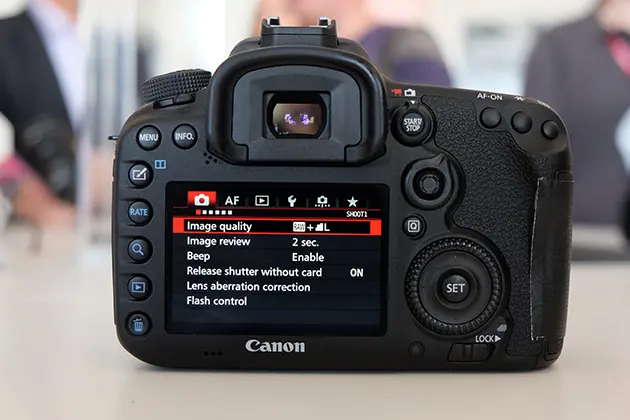
With this 6th lesson of the online photography course, we have completed the light path started last time. In the next lesson, we will talk about memory cards.
If you missed the previous lessons, go to this link to see the index of all the lessons.



